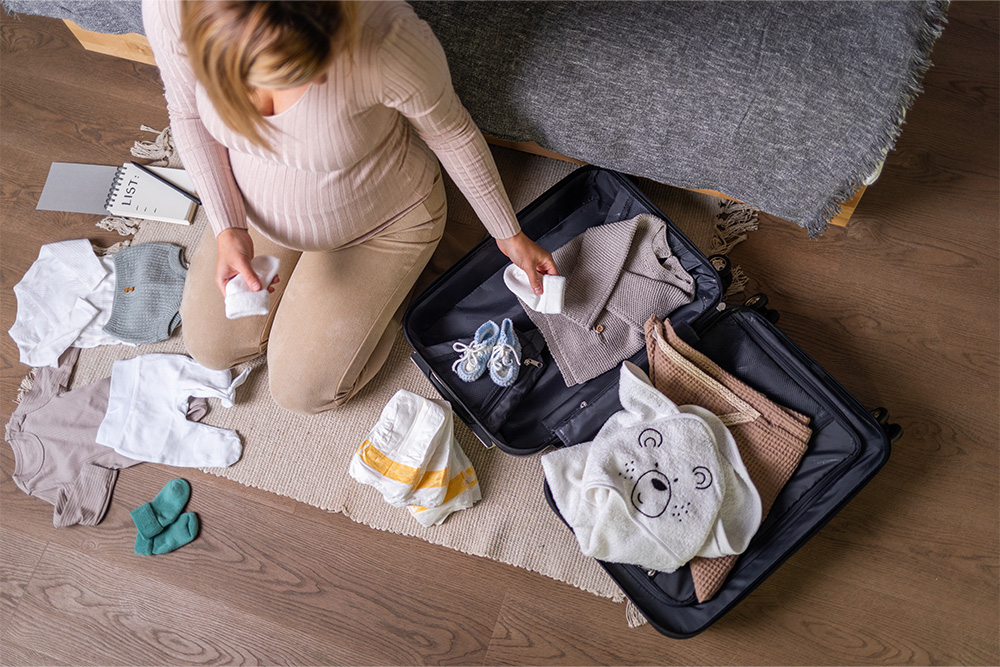
Packing your hospital bag can be one of those pregnancy milestones that makes everything suddenly feel very real. Your due date is getting closer, your baby is almost here, and you are faced with the question: What do I actually need to take with me?
The good news is that your hospital bag does not need to contain everything you own — or everything you have seen recommended online.
The aim is simple: pack enough to keep you comfortable, prepared and supported through labour, birth and the first days afterwards, while remembering that every maternity unit is different.
Your hospital may provide some items, while others may be essential for you to bring. Before packing, ask your maternity unit or healthcare team for their specific requirements.
When Should You Pack Your Hospital Bag?
There is no single perfect week to pack your bag. A practical approach is to start gathering items during the early third trimester and have the main bag ready by around 35–36 weeks.
Better Health Channel recommends beginning to organise your bag from around 29 weeks and having it packed by approximately 36 weeks, while Pregnancy, Birth and Baby similarly recommends planning ahead because labour may not begin exactly when expected (Better Health Channel, 2024; Pregnancy, Birth and Baby, 2026).
If you have been advised that you may deliver earlier, have a planned induction or caesarean birth, or have a pregnancy that requires closer monitoring, your doctor may recommend being prepared sooner.
And remember: being prepared does not mean expecting something to go wrong. It simply means giving yourself one less thing to think about when the time comes.
Start With Three Bags, Not One
Instead of putting everything into one large suitcase, consider dividing your things into three smaller sections:
1. Labour bag
The things you may need immediately when you arrive.
2. Post-birth bag
Clothing, toiletries and recovery essentials for after your baby is born.
3. Baby bag
Your newborn’s clothes, nappies and going-home essentials.
This makes it much easier for your birth partner to find what you need without unpacking your entire bag while you are in labour.
You can even label the sections LABOUR, MUM and BABY.
Your Labour Essentials
The first part of your bag should be easy to access.
Documents and Medical Information
Having these documents ready can make admission smoother and means you are not searching through your phone or handbag while contractions are becoming more intense.
Keep these together in a clearly labelled folder:
- Antenatal records or maternity notes
- Hospital admission documents
- Medical aid or insurance information
- Personal Identification
- Your doctor’s or maternity team’s contact details
- Emergency contact information
- Your birth preferences or birth plan, if you have one
- A list of medications you regularly take
- Any relevant medical information your care team may need
How These Documents Help During Labour
These documents give your maternity team a clear overview of your pregnancy and help them make informed decisions throughout labour and birth. Your antenatal records may include your medical history, blood group, test results, scan reports, allergies, medications and details of any pregnancy-related concerns.
Your birth preferences can help your healthcare team understand what matters to you, such as your preferred comfort measures, who you would like to present, your thoughts on pain relief or your wishes around skin-to-skin contact.
They are not a guarantee that everything will happen exactly as planned, but they provide a useful starting point for discussion.
Admission, identification and medical aid documents can help reduce delays when you arrive at the hospital, while your medication list and relevant medical information help your care team provide safer, more personalised care. Keep the folder somewhere your birth partner can reach easily, and make sure they know what it contains in case you are focused on contractions or need support during admission.
If your maternity unit uses electronic records or requires specific forms, check in advance whether you need to bring printed copies as well.
Clothing for labour
Choose comfort over appearance.
Consider packing:
- A loose, old T-shirt or nightdress
- Comfortable underwear
- Warm socks
- A lightweight dressing gown
- Slippers or non-slip footwear
- A change of clothing if your first outfit becomes uncomfortable or soiled
- If you are planning to use a birth pool or shower for comfort, check your hospital’s policy and whether you need to bring suitable swimwear.
These options are useful because labour can be physically demanding, and comfortable, breathable clothing allows you to move more easily and change positions without feeling restricted.
Warm socks, a dressing gown and non-slip footwear can help you stay comfortable between contractions or while walking around the maternity unit, where floors and rooms may feel cool.
Choosing older or easily washable items also means you do not have to worry if clothing becomes damp, stained or soiled during labour.
Comfort Items
This is where your hospital bag becomes personal.
You might want:
- Lip balm
- Hair ties or a headband
- A small fan or spray bottle
- Massage oil or lotion, if permitted
- A TENS machine if you plan to use one
- Headphones or a small speaker
- A familiar playlist
- A pillow from home
- An eye mask or earplugs
- A small heat or cold pack if approved by your maternity unit
- Light snacks and drinks
These items can help make the hospital environment feel more familiar and manageable during labour. Lip balm, a fan or spray bottle and heat or cold packs may help with physical discomfort, while massage, a TENS machine and familiar music can support relaxation and coping with contractions.
A pillow, eye mask and earplugs may also help you rest between periods of activity, and simple items such as hair ties can keep you comfortable and focused as labour progresses.
A drink bottle with a straw can also be useful during labour, particularly when you are lying down or changing positions. Snacks and drinks may be appropriate depending on your individual clinical circumstances and your healthcare team’s advice.
These things are not requirements for giving birth. They are simply tools that may make your environment feel more familiar and comfortable.
What To Pack For After The Birth
Your body has just done something significant. Think soft, loose and practical.
You can pack:
- 2–3 comfortable nightdresses or pyjamas
- A dressing gown
- Slippers or comfortable footwear
- Several pairs of large, high-waisted underwear
- Disposable maternity underwear, if you prefer
- 2–3 comfortable, supportive bras
- Nursing bras if you plan to breastfeed
- Breast pads
- Maternity pads
- Loose clothing for daytime
- A comfortable outfit for going home
- If you have a caesarean birth, high-waisted underwear and loose clothing can be particularly useful because you want to avoid pressure or friction around the incision.
After birth, your body needs comfort, support and easy-to-wear clothing while you recover and adjust to caring for your baby.
Soft nightwear, a dressing gown and comfortable footwear can help you feel more at ease during your hospital stay, while high-waisted underwear, maternity underwear and pads provide practical support during postpartum bleeding.
Supportive or nursing bras and breast pads can help with breast changes and feeding, and loose daytime clothing and a comfortable going-home outfit make movement easier without putting pressure on sensitive areas.
You may also want a separate laundry bag for clothing that becomes wet or soiled.
Your Personal-Care Kit
A small toiletry bag can make hospital life feel considerably more comfortable.
It Would Be Wise To Pack:
- Toothbrush and toothpaste
- Deodorant
- Face wash
- Soap or shower gel
- Shampoo and conditioner
- Hairbrush
- Hair ties
- Lip balm
- Moisturiser
- Sanitary or maternity pads
- Any personal hygiene products you normally use
- Contact lenses and solution, if applicable
- Glasses and a protective case
Keep these somewhere accessible rather than buried at the bottom of your suitcase.
Your Baby’s Hospital Bag
Newborns need surprisingly little.
Start with:
Clothing
- 3–5 vests or bodysuits
- 3–5 sleepsuits
- 2–3 pairs of socks or booties
- A hat
- A cardigan or warm layer, depending on the season
- A going-home outfit
- One or two blankets or wraps
- Muslin cloths
These items help keep your newborn warm, comfortable and clean during your hospital stay and on the journey home.
Choose clothing that is easy to put on and remove. Newborn dressing is not the time for complicated buttons. Vests, sleepsuits and a warm layer provide practical clothing for changing temperatures, while socks or booties and a hat help protect tiny hands, feet and head from the cold.
A going-home outfit ensures your baby is dressed appropriately for travel, blankets or wraps provide extra warmth and security, and muslin cloths are useful for burping, wiping spills and protecting clothing during feeds
Nappies and Changing
Check what your hospital supplies first.
Depending on their policy, you may need:
- Newborn nappies
- Cotton wool or baby wipes
- Nappy cream, if recommended
- Disposable bags for used nappies or dirty clothing
We recommend allowing approximately 8–10 nappies per day, although your hospital’s requirements and the length of your stay will determine how many you actually need to bring.
For The Journey Home
Leaving the hospital with your baby can feel overwhelmingly emotional. After months of imagining this moment, you may suddenly find yourself holding your newborn, carrying a small bag of belongings and preparing to walk out as a parent.
You may feel excited, relieved, overwhelmed or unsure — sometimes all at once. The journey home can be the first moment when the hospital doors close behind you and the reality of caring for your baby begins to feel very real. There is no “right” way to feel. Some parents feel ready to leave, while others wish they could stay a little longer in the safety and support of the maternity unit.
If you are travelling home by car, make sure your baby’s infant car restraint is installed correctly before the day of discharge. We specifically recommend checking the car seat installation and having your transport plan ready before labour begins or by the latest, the day before you are discharged from the hospital.
Try to make the journey as calm and unhurried as possible.
Your baby may sleep through the journey, cry, or simply seem very small and unfamiliar in the car seat. You do not need to make the trip perfect. Your role is simply to get home safely, with your baby secured correctly and your support person nearby.
Keep the first trip simple, avoid unnecessary stops and have a few essentials within reach, such as a blanket, muslin cloth, nappies and water for yourself.
When you arrive home, give yourself permission to pause. You may want to take a photograph, sit quietly, cry, laugh or simply look at your baby and take in the moment. The first hours at home do not need to be productive or organised. You have already done something enormous.
Don’t Forget Your Birth Partner
Your birth partner may spend many hours with you, so their comfort matters too.
Their bag can include:
- Comfortable clothing
- A change of clothes
- Comfortable shoes
- Toiletries
- Phone and charger
- Snacks and drinks
- Any regular medication
- Cash or a card for parking or refreshments
- Headphones
- A pillow if permitted
- A list of important contact numbers
Perhaps their most important job is knowing where everything is. However, a well-packed bag is only useful if your partner knows where to find the maternity pads, your water bottle, the baby’s first outfit or your lip balm when you ask for them.
Continuous support during labour can provide emotional reassurance, practical assistance and advocacy.
A Cochrane review involving more than 15,000 women found that continuous support was associated with several positive outcomes, including greater satisfaction with childbirth and lower rates of caesarean birth, although the evidence quality varied across outcomes (Bohren et al., 2017).
WHO therefore recommends a companion of choice throughout labour and childbirth as part of respectful, woman-centred maternity care (World Health Organization, 2018).
A Few Things You Probably Don’t Need
It is easy to overpack.
You probably do not need:
- Multiple outfits for every possible scenario
- Large amounts of baby equipment
- Expensive valuables or jewellery
- Full-sized toiletries
- Every newborn gadget you have bought
- Large amounts of cash
- Anything your hospital already provides
Different maternity units have different policies and supplies, so check first before buying or packing multiples of something (Better Health Channel, 2024).
The best hospital bag is not necessarily the biggest one. It is the one where you can find what you need quickly.
One Small Thing That Can Make A Big Difference
Consider packing a small “first hour” pouch.
Put the things you may want immediately after birth in one easily accessible place:
For you:
Lip balm, maternity pad, clean underwear and a fresh nightdress.
For baby:
Nappy, vest, sleepsuit, hat and blanket.
If immediate skin-to-skin contact is planned and medically appropriate, having your baby’s first outfit nearby means it can remain untouched while you and your baby have that important early contact.
Evidence from a 2025 Cochrane review involving 69 studies and 7,290 mother-infant pairs found that immediate or early skin-to-skin contact probably improves early exclusive breastfeeding and supports newborn adaptation, including blood glucose and physiological stability (Moore et al., 2025). You can read more about the importance and process for skin-to-skin contact after birth on our website.
Your healthcare team will guide you if you or your baby need medical attention first. Birth does not always follow the plan — and that is okay.
The Maxima Takeaway
Your hospital bag is not a test of how prepared you are for motherhood. You do not need to anticipate every possibility.
Pack the essentials, make your comfort a priority, know your hospital’s requirements and involve your birth partner in the plan.
Most importantly, remember that your bag is there to support you — not to create another list you feel you have to get perfectly right.
Your birth may unfold differently from what you imagined. Being prepared means giving yourself the practical support to meet whatever comes next.
Ready for Birth?
Talk to the Maxima Women’s Health team about preparing for your birth, your hospital stay and the questions you want answered before the big day.
Feeling informed can make the unknown feel a little less overwhelming.
Start The Conversation And Prepare With Confidence
Have questions about your upcoming birth?
Book a consultation with the Maxima Women’s Health team. Discuss your birth preferences, pain-relief options and hospital preparation with us.
Follow for more on your pregnancy journey
Follow our social media and subscribe to our newsletter to explore more evidence-based pregnancy and birth guidance from Maxima Women’s Health.
Leave a Reply