
Choosing contraception is a very personal and very life-changing decision. Deciding which contraceptive method is right for you can take time.
You may be looking for something reliable and long-lasting, hoping to avoid hormones, or wondering whether an IUD could help with heavy or painful periods. It is completely normal to have questions about how IUDs work, what insertion feels like and which option may suit your body and lifestyle.
At Maxima Women’s Health, we believe contraception decisions should be informed by clear, personalised advice.
This article is educational content based on guidelines. It does not replace personalised medical advice. Whether an IUD is suitable for you specifically, and which type, is a decision to make in consultation with a doctor who knows your full history.
In this guide, we explain the basics of IUDs and the key differences between the available options.
What is an IUD?
An intrauterine device, commonly called an IUD, is a small, flexible contraceptive device placed inside the uterus by a trained healthcare professional.
IUDs are considered one of the most effective forms of reversible contraception. Both copper and hormonal IUDs have fewer than one pregnancy per 100 women during the first year of typical use, and fertility returns after the device is removed (World Health Organization, 2026).
Unlike contraceptive pills, patches or rings, an IUD does not require you to remember something every day, week or month. Once inserted, it provides continuous contraception for several years, depending on the type and specific product.
There are two main types:
- Copper IUDs – create an environment within the uterus that interferes with sperm movement and function, making fertilisation very unlikely. It does not contain or release reproductive hormones.
- Hormonal IUDs – also called levonorgestrel-releasing intrauterine systems (LNG-IUS), which release a small amount of the hormone levonorgestrel within the uterus.
Both are highly effective. The important question is not simply which one “works better”, but which one fits your body, your periods, your preferences and your reproductive plans.
Copper vs Hormonal IUD: What Is the Difference?
Although both devices sit inside the uterus, they prevent pregnancy in slightly different ways and can have noticeably different effects on your menstrual cycle.
Copper IUD
The copper IUD is considered non-hormonal.
Copper creates an environment within the uterus that interferes with sperm movement and function, making fertilisation very unlikely. It does not contain or release reproductive hormones.
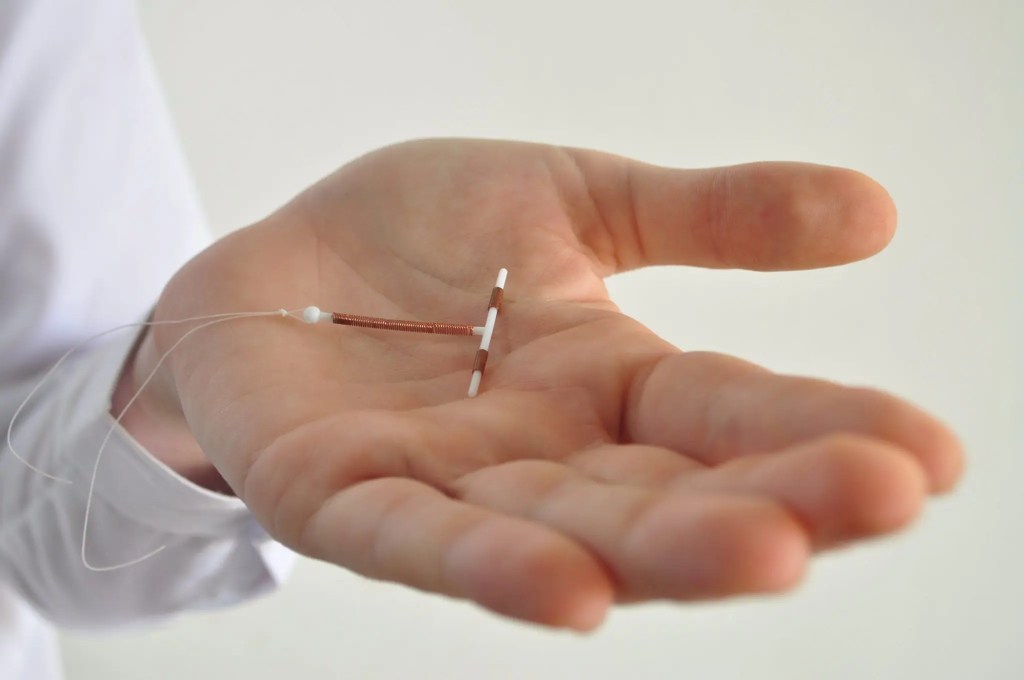
Depending on the specific product, copper IUDs can provide contraception for many years. The World Health Organization reports that some copper IUDs can remain effective for up to 10–12 years (World Health Organization, 2026).
The main consideration is your period. Copper IUDs can cause periods to become heavier, longer or more painful, particularly during the first few months after insertion. If you already experience heavy menstrual bleeding or significant period pain, this is an important part of the conversation before choosing a copper IUD.
Copper IUDs may also be called:
- Copper intrauterine devices.
- Copper coils.
- Non-hormonal IUDs.
- Copper-bearing IUDs.
- Copper T devices, referring to the T-shaped design used by many products.
A copper IUD may be particularly appealing if you:
- You want highly effective contraception without hormones.
- You prefer to maintain your natural hormonal cycle.
- You do not want to take a daily contraceptive.
- You want a long-term method.
- You would like an option that can also be used as emergency contraception when inserted within five days of unprotected intercourse.
IUD brand names vary by country and may include Paragard, Mona Lisa, Flexi-T, Multiload and other locally approved products. These devices can differ in shape, copper surface area, size and approved duration, so the brand name alone does not tell you everything about how a particular IUD will suit you.
Copper IUDs Available in South Africa
Availability can vary between public-sector clinics, private gynaecology practices and pharmacies. Always ask what is available to you before making a decision.
The specific product offered may also change over time, so confirm current registration and availability with a healthcare professional or the South African Health Products Regulatory Authority (SAHPRA).

What To Ask Before Choosing A Copper Iud
- What is the exact brand and model being offered?
- How long is that specific device approved for use in South Africa?
- Is it registered with SAHPRA?
- Will it be available through a public clinic, private practice or pharmacy?
- Could it make your periods heavier or more painful?
- Is it suitable if you have heavy menstrual bleeding, fibroids, pelvic pain or a history of pelvic infection?
- Do you need condoms as well for STI protection?
Copper IUD Comparison
A copper IUD is hormone-free and highly effective, but it may not be the best option for someone who already has heavy or painful periods.
A healthcare professional can help you compare the available device with a hormonal IUD and choose the option that best fits your health, menstrual pattern and reproductive plans.
Hormonal IUD
A hormonal IUD releases what is called ‘levonorgestrel’, this is a form of progestogen, primarily found within the uterus.
It works mainly by thickening cervical mucus, making it difficult for sperm to enter the uterus, and by thinning the uterine lining. Ovulation may still occur in many users, depending on the specific device and individual response.

Hormonal IUDs last between three and eight years depending on the device, although the exact approved duration varies by product and indication.
One of the biggest differences women notice after getting hormone IUD’s is often changes in their period. Hormonal IUDs commonly make menstrual bleeding lighter and shorter, and some women eventually have little or no bleeding at all.
This can be particularly useful for women who experience:
- Heavy periods
- Painful periods
- Anaemia related to menstrual blood loss
- Some forms of heavy menstrual bleeding
- Certain conditions where reducing the thickness of the uterine lining is beneficial
A 2024 meta-analysis of 20 randomised controlled trials found that levonorgestrel IUDs were associated with lower risks of increased bleeding, heavy bleeding and dysmenorrhoea compared with copper IUDs, although hormonal IUD users were more likely to experience amenorrhoea (Liu et al., 2024).
Different Types Of Hormonal IUD’s Available in South Africa

How Should You Interpret These Differences?
The exact duration, approved uses and availability can depend on the specific product registered in South Africa. A healthcare professional can confirm which options are currently available and appropriate for you.
Hormonal IUDs do not protect against sexually transmitted infections, including HIV, so condoms may still be needed for STI protection.
Hormonal IUDs last between three and eight years depending on the device, although the exact approved duration varies by product and indication (World Health Organization, 2026).
How Do IUDs Affect Your Period?
For many women, period changes are one of the most important differences between the two options. With a copper IUD, periods may initially become heavier or longer and cramps may become more noticeable.
With a hormonal IUD, irregular spotting or bleeding is common during the first few months. Over time, bleeding generally becomes lighter, and some women stop having periods altogether.
A three-year randomised study comparing a levonorgestrel IUD with a copper IUD found that by 36 months, median bleeding days were substantially lower with the hormonal device. Forty percent of participants using the lower-dose hormonal IUD experienced amenorrhoea compared with none in the copper IUD group (Bahamondes et al., 2023).
Not having a period while using a hormonal IUD is not the same as having an unhealthy menstrual cycle.
The hormonal levels you incur whilst having an IUD cause the uterine lining to remain thin, meaning there may simply be very little lining available to shed. However, if changes in your bleeding pattern are important to you, they should form part of your decision before insertion.
What About Painful Periods?
If you experience significant menstrual cramps, the hormonal IUD may offer an additional benefit.
Research comparing hormonal IUDs with other treatments for dysmenorrhoea has found reductions in menstrual pain, although the strength of evidence varies depending on the underlying cause of the pain (Wang et al., 2022).
Hormonal IUDs have also been studied in women with conditions such as adenomyosis and endometriosis, where reducing menstrual bleeding and pain may form part of a broader treatment plan.
This does not mean that an IUD treats every cause of pelvic pain. If you have severe or worsening period pain, pain during sex, chronic pelvic pain or other concerning symptoms, it is important to investigate the underlying cause rather than simply treating the bleeding pattern.
Determining Which IUD Is Right for You
There is no universally “best” IUD.
The better question is to compare your options and then make a decision that fits best for you.
What matters most to you?
You can use our IUD decision guide for a way forward.
This 3-page table is a starting point rather than a recommendation. Your medical history, menstrual pattern, age, reproductive plans, previous pregnancies, risk of STIs, uterine anatomy and personal preferences all matter.
Download our IUD Consideration Guide Here Below
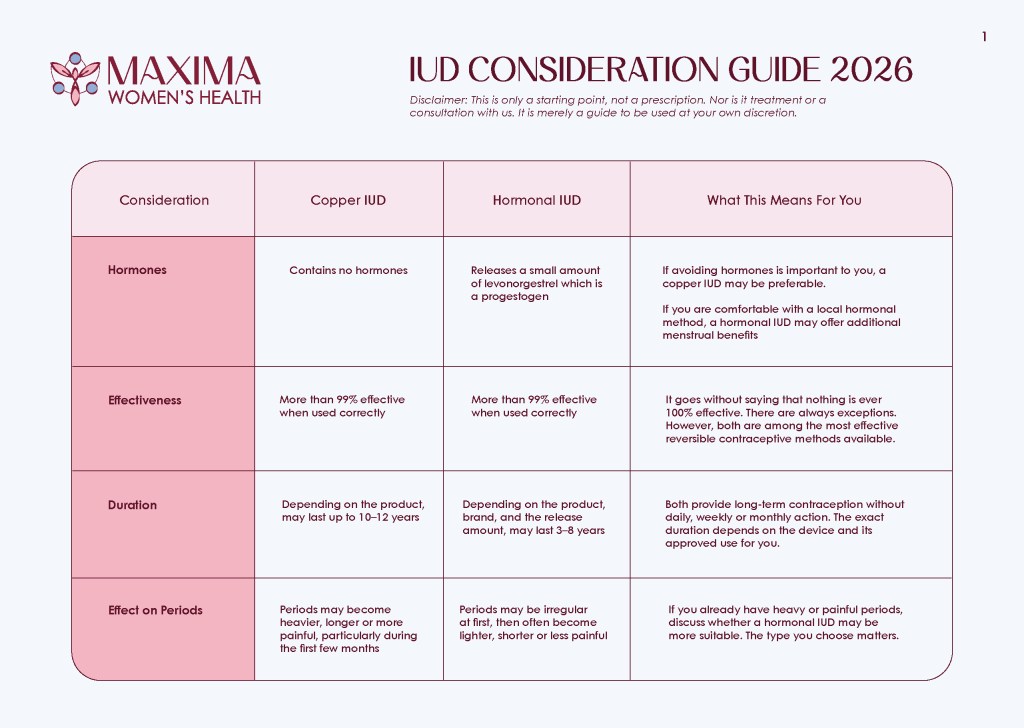
A healthcare professional can help you compare the specific devices available to you and consider your medical history, menstrual pattern, reproductive plans and preferences. It is also important to know what you do not want.
You may not want hormones. You may not want heavier periods. You may not want to think about contraception every day. You may want to reduce menstrual bleeding. You may want something you can remove whenever your plans change.
Those preferences are clinically relevant. Therefore, we recommend you book a consultation with us in order to choose the best option for you.
When An IUD Isn’t Suitable
Most women can safely use an IUD.
Conditions that make one or both types unsafe include:
- Pregnancy (known or suspected)
- A uterine cavity distorted by large fibroids or congenital abnormalities
- Current pelvic infection or untreated STIs
- Unexplained vaginal bleeding pending investigation
- Active cervical or endometrial cancer
- Current breast cancer (for hormonal IUDs only)
- Copper allergy or Wilson’s disease (for copper IUDs only)
A full medical history and examination before insertion is how these things are checked.
From The Consulting Room
IUDs are considered safe and suitable for most people, but like any medical procedure, they carry some potential risks.
During your consultation, your healthcare provider will review your medical history, menstrual pattern, reproductive plans and any relevant symptoms to help determine whether a copper or hormonal IUD is appropriate for you.
Here are some questions that we have been asked that you might also have and benefit from.
“Does The Brand You Use Affect Insertion?”
It can. Some hormonal IUDs have a smaller frame or narrower inserter than others. This may be relevant for people with a smaller uterine cavity, although a smaller device does not guarantee a pain-free insertion.
Your healthcare provider may consider:
- The size and shape of your uterus.
- Whether you have previously given birth.
- Your bleeding pattern.
- Your reason for choosing an IUD.
- Whether you want the device for contraception, heavy menstrual bleeding or both.
- The duration of contraception you want.
- Which products are available in your country?
The most suitable IUD is therefore not always the one with the lowest hormone dose or the longest duration. It is the one that best balances your medical needs, menstrual preferences, anatomy and reproductive plans.
Although both devices sit inside the uterus, they prevent pregnancy in slightly different ways and can have noticeably different effects on your menstrual cycle.
“Is IUD Insertion Painful?”
An IUD is inserted through the vagina and cervix into the uterus. The procedure is usually relatively quick, but the experience varies considerably between individuals.
Some women experience:
- Cramping
- Pressure
- Sharp, short-lived discomfort
- Light bleeding afterwards
- Stronger cramps for several hours after insertion
Others experience very little discomfort. It is important not to assume that insertion will feel the same for everyone. It is also important to know your options for how it might affect you.
Women who have never given birth may experience more insertion difficulty or pain in some studies, although IUDs remain a suitable contraceptive option for women who have not had children (Bahamondes et al., 2018).
Your healthcare provider can discuss pain-management options with you beforehand. You should never feel that you simply have to tolerate significant pain without support or explanation.
“Is Having an IUD Safe To Have?”
For most eligible women, IUDs are considered safe and highly effective. Like any medical procedure, however, they have potential risks. These can include:
Expulsion
Sometimes an IUD can partially or completely come out of the uterus. This is more likely during the early period following insertion.
If you notice the device coming out, feel that the strings have changed significantly, or cannot feel them when you normally can, contact your healthcare provider for advice.
Infection
The risk of pelvic infection associated with insertion is low, but it is higher when certain sexually transmitted infections are present at the time of insertion. Appropriate sexual health screening and assessment can help reduce this risk.
Importantly, IUDs do not protect against sexually transmitted infections, including HIV. Condoms remain important when STI protection is needed (World Health Organization, 2026).
Perforation
Very rarely, the device can pass through the wall of the uterus during insertion.
Perforation is uncommon, although risk can be higher in certain circumstances, including insertion during breastfeeding or in the postpartum period. A recent systematic review found that perforation remained rare but was more frequent among breastfeeding women (Nelson et al., 2025).
Your individual circumstances should therefore be considered when deciding when an IUD should be inserted.
“Can You Get Pregnant With an IUD?”
Yes, although it is very uncommon. IUDs are among the most effective forms of contraception, but no contraceptive method is completely failproof. If pregnancy occurs while an IUD is in place, it is important to contact your healthcare provider promptly.
The first step is usually to confirm the pregnancy and check where it is located. An ultrasound may be recommended to determine whether the pregnancy is inside the uterus or ectopic, meaning it has developed outside the uterus.
Although IUDs do not cause an ectopic pregnancy, if pregnancy occurs with an IUD in place, the relative likelihood of an ectopic pregnancy is higher and needs to be assessed urgently.
Seek immediate medical attention if you have:
- One-sided or severe abdominal or pelvic pain
- Shoulder-tip pain
- Dizziness, fainting or weakness
- Heavy vaginal bleeding
- Feeling suddenly unwell
If the pregnancy is inside the uterus, your healthcare provider will discuss whether the IUD can be safely removed. If the strings are visible, removal is generally recommended as early as possible because leaving the IUD in place increases the risk of miscarriage, infection and preterm birth.
However, removal also carries a small risk of miscarriage, so it should be performed by a trained healthcare professional. Do not try to remove the device yourself.
If the IUD strings cannot be seen, your healthcare provider may use an ultrasound or other assessment to locate the device and discuss the safest next steps. The recommended approach depends on the type of IUD, how far along the pregnancy is and where the device is positioned.
“Can You Get Pregnant After an IUD?”
Yes. One of the advantages of both types of IUD is that they are reversible.
An IUD does not typically affect your ability to become pregnant after it is removed. Fertility can return rapidly, and evidence examining fertility after IUD removal has generally been reassuring, with pregnancy rates comparable to those expected in the wider population (Toivonen, 2008).
Older prospective research also found high conception rates following removal of both copper and levonorgestrel-releasing IUDs, with no evidence of delayed return to fertility attributable to the devices themselves (Andersson et al., 1992).
An IUD therefore does not need to be reserved for women who have completed their families. It can be used as a spacing method for someone who wants children in the future.
The Maxima Takeaway
The right contraceptive is not simply the most effective one on paper — it is the one that fits your body, your health and the life you are living.
Copper and hormonal IUDs are both highly effective, long-acting and reversible options, but they can affect your periods and your experience differently.
Choosing between them should be a conversation rather than a checklist.
At Maxima Women’s Health, we believe contraception should be approached with information, honesty and respect for your individual choices. You deserve to understand how a method works, what you can expect from it and what alternatives are available before making a decision.
Ready to explore your options?
Book a consultation with Maxima Women’s Health to discuss which contraceptive option may be appropriate for your body, health history and reproductive goals.
The right choice starts with a conversation that is about you.
Need more information about the possibilities?
Bring your questions with you after you book your consultation.
At Maxima Women’s Health you can talk to our professionals, they will guide you through the benefits, limitations, side effects and practical considerations of different contraceptive methods so you can make an informed decision.
You do not need to arrive knowing what you want — that is what the consultation is for.
Leave a Reply