
Medical disclaimer:
This article is for general educational purposes and does not replace an individual medical assessment, diagnosis or treatment plan.
Cancer care during pregnancy must be guided by qualified healthcare professionals familiar with the specific diagnosis and pregnancy.
———
A cancer diagnosis can be overwhelming at any point in life. When it happens during pregnancy, it can bring an additional layer of uncertainty: how will treatment affect your health, what does it mean for your baby, and can both cancer care and pregnancy care continue together?
Cancer during pregnancy is uncommon, but it does happen. It may be diagnosed for the first time during pregnancy, or a woman may become pregnant while receiving treatment or after a previous diagnosis. Breast cancer, cervical cancer, melanoma and blood cancers are among the malignancies that may occur during the reproductive years.
The important thing to understand is that a cancer diagnosis during pregnancy does not automatically mean that the pregnancy must end or that the baby will be harmed. Many treatment decisions can be adapted to the stage of pregnancy, although some therapies cannot safely be given until after delivery.
The risks depend on several factors, including the type and stage of cancer, how quickly it is growing, when it is diagnosed, which treatments are needed and the mother’s overall health. Modern evidence supports individualised treatment planning, with the oncology and obstetric teams working together from the beginning (Nanda et al., 2025).
Let’s look at what this means for both mother and baby.
How Common Is Cancer During Pregnancy?
Cancer diagnosed during pregnancy is sometimes called pregnancy-associated cancer. The term can also be used more broadly for cancer diagnosed around pregnancy or shortly after birth, although the exact definition varies between studies.
The Society for Maternal-Fetal Medicine estimates that approximately 1 in 1,000 pregnancies is complicated by a cancer diagnosis each year. Cancer during pregnancy is relatively rare, therefore, much of the available evidence comes from observational studies, patient registries and specialist clinical experience rather than randomised trials (Society for Maternal-Fetal Medicine, 2026).
The cancers involved generally reflect those found in women of reproductive age. Breast cancer, cervical cancer, melanoma, lymphoma and other blood cancers are among the important diagnoses clinicians may encounter.
Pregnancy can also make certain symptoms more difficult to recognise. Breast enlargement, nausea, fatigue, changes in bowel habits and abdominal discomfort can overlap with symptoms that might otherwise prompt further investigation.
This does not mean that pregnancy causes cancer.
Rather, normal pregnancy changes can sometimes make an existing condition harder to identify promptly. Unusual, persistent or worsening symptoms should not automatically be attributed to pregnancy. Appropriate investigation remains important.
How Can Cancer Affect The Mother?
Cancer affects the body differently depending on where it develops, how advanced it is and how aggressively it behaves.
In addition, pregnancy brings physiological changes that may influence how the condition is investigated and managed.
Delayed Diagnosis and Cancer Progression
One concern is that symptoms may be mistaken for ordinary pregnancy changes, potentially delaying diagnosis.
For example, a new breast lump may be attributed to breast enlargement, while persistent abdominal discomfort might be dismissed as pregnancy-related. Some cancers can progress during a delay, although the extent of this risk depends on the individual cancer and its biology.
Pregnancy itself does not necessarily make cancer more aggressive. However, a delay in diagnosis may affect the stage at which cancer is discovered and the treatment options available.
For this reason, clinicians should investigate concerning symptoms promptly rather than waiting until after delivery.
Changes In Physical Health and Pregnancy-Related Complications
Cancer can place additional demands on the body. Depending on the diagnosis, women may experience pain, fatigue, weight loss, reduced appetite, anaemia or complications affecting the organs involved.
Cancer and pregnancy can also increase the risk of blood clots. Pregnancy already makes the blood more likely to clot, while certain cancers, surgery, hospital admission and some cancer treatments can increase that risk further. The medical team may assess whether preventive anticoagulant medication is appropriate (Nanda et al., 2025).
Other possible concerns include infection, bleeding, nutritional difficulties and reduced physical functioning during treatment.
These risks are not the same for everyone. A woman with a small, localised tumour may have a very different pregnancy course from someone with an advanced cancer requiring urgent systemic treatment.
What Are The Potential Risks On The Baby?
The risks to a developing baby depend largely on the cancer itself, the mother’s health, the treatments used and the stage of pregnancy at exposure.
It is important to distinguish between risks caused by the mother’s illness and those associated with treatment or an early delivery.
Miscarriage and Pregnancy Loss
Severe maternal illness can affect pregnancy, and some cancer treatments can increase the risk of pregnancy loss. However, a cancer diagnosis does not automatically mean that a miscarriage will occur.
The level of risk depends on the cancer, its severity, treatment requirements and gestational age. Evidence is limited for some uncommon cancers and newer therapies, so individual counselling with an oncology team is essential.
Birth Defects and Early Fetal Development
The first trimester is a particularly sensitive period because the baby’s major organs are developing. Certain anticancer medicines can interfere with cell division and organ formation, which is why many systemic cancer treatments are avoided during this stage.
The risk varies by medicine and timing of exposure. Chemotherapy given during early pregnancy has been associated with a higher risk of congenital abnormalities than treatment started later in pregnancy (Nanda et al., 2025).
This is one reason treatment plans must account for gestational age. If a woman has received a medicine before discovering she is pregnant, the medical team should review the specific drug, dose and timing rather than assuming that harm has occurred.
Restricted Fetal Growth and Low Birth Weight
Some pregnancies affected by cancer have an increased risk of fetal growth restriction, where the baby does not grow as expected, or of being born with a low birth weight.
Possible contributing factors include maternal illness, placental function, nutritional difficulties, cancer treatment and complications that lead to early delivery.
Serial ultrasound examinations may be recommended to monitor the baby’s growth and wellbeing. These scans allow the team to identify concerns and adjust the pregnancy management plan where necessary.
Premature Birth
Prematurity is one of the important risks in pregnancies complicated by cancer.
An early birth may be recommended if the mother’s condition requires treatment that cannot safely be delayed, or if an obstetric complication develops. In other cases, clinicians may consider delivering early to create a treatment window after birth.
However, early delivery is not automatically the safest option. Babies born prematurely may experience breathing difficulties, feeding problems, temperature instability and other complications related to their gestational age.
Where medically possible, healthcare teams aim to avoid an unnecessarily early birth. The Society for Maternal-Fetal Medicine recommends that planned delivery before 37 weeks should generally be avoided unless there is a medical or obstetric reason to proceed earlier (Society for Maternal-Fetal Medicine, 2026).
Stillbirth and Neonatal Complications
Some studies report higher rates of stillbirth and neonatal complications in pregnancies affected by cancer. These outcomes are influenced by several factors, including the cancer diagnosis, treatment exposure, maternal complications and prematurity.
This does not mean that stillbirth is an inevitable or expected outcome. Many women with cancer have babies who survive and do well, but the level of monitoring needed will depend on the individual clinical situation.
The neonatal team may need to prepare for additional assessment after birth, particularly if the baby was born prematurely or exposed to certain medicines before delivery.
How Does Cancer Treatment Change During Pregnancy?
Cancer treatment is not one-size-fits-all. Some therapies can be used during pregnancy, others must be delayed, and some are generally avoided until after delivery.
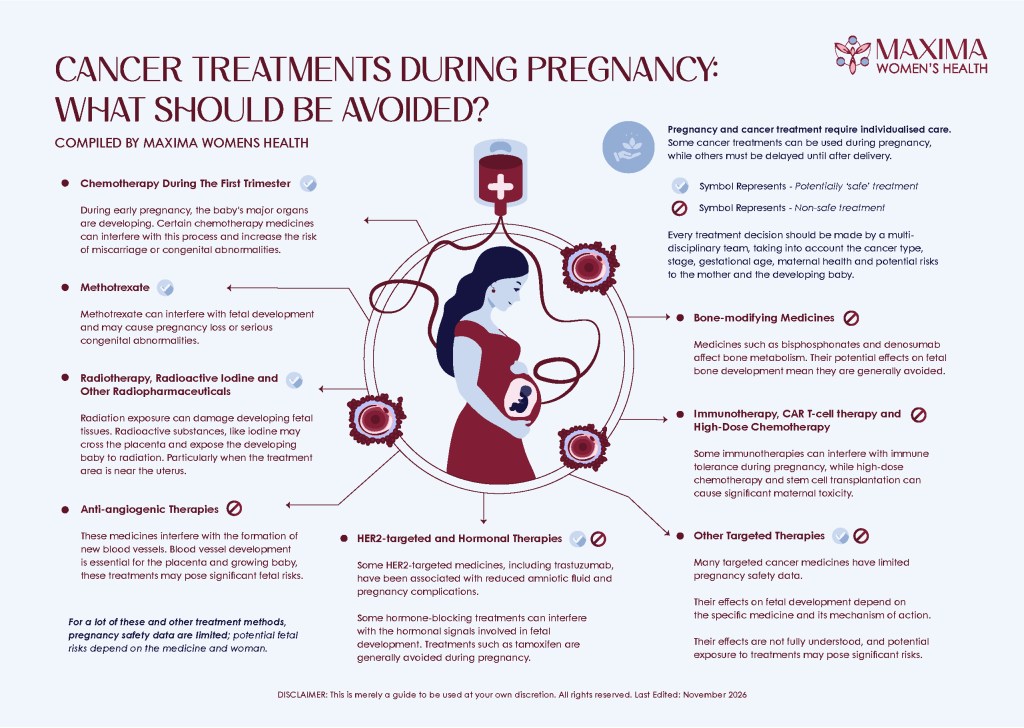
The goal is to treat the mother’s cancer effectively while reducing avoidable risks to the developing baby.
Surgery
Surgery may be possible during pregnancy when it is needed to diagnose or treat cancer. The decision depends on the procedure, the location of the tumour, the mother’s condition and the stage of pregnancy.
Pregnancy does not automatically prevent necessary surgery. The surgical, anaesthetic, oncology and obstetric teams assess the risks and plan appropriate monitoring.
For some cancers, surgery can proceed without waiting until delivery. For others, the timing or extent of surgery may need to be adapted.
Chemotherapy
Chemotherapy uses medicines that target cancer cells, often by interfering with cell growth and division. Because these processes are also important during fetal development, timing is critical.
Many chemotherapy regimens are avoided during the first trimester because of the risk of miscarriage and congenital abnormalities. Certain medicines may be considered during the second and third trimesters when the benefits outweigh the risks, but safety depends on the specific drug and cancer.
Chemotherapy is generally stopped before delivery to allow the mother’s and baby’s blood counts to recover and reduce the risk of complications around birth. The timing depends on the regimen and the planned delivery date (Nanda et al., 2025).
Radiotherapy
Radiotherapy uses high-energy radiation to destroy cancer cells. Radiation exposure can harm a developing fetus, particularly when the treatment field is near the uterus.
For this reason, radiotherapy is generally avoided during pregnancy. In rare circumstances where treatment is urgent, specialist teams may assess whether any approach is appropriate, but the risks require careful consideration.
Targeted Therapy, Immunotherapy and Hormonal Treatment
Some newer cancer treatments work by targeting specific molecular pathways, stimulating immune responses or altering hormone activity.
These treatments cannot be assumed safe simply because they are more targeted than conventional chemotherapy. Many have limited pregnancy safety data, and some are contraindicated because of known or potential risks to fetal development.
For example, methotrexate and certain hormonal or targeted therapies are generally avoided during pregnancy. Treatment decisions must be made for the specific medicine and cancer rather than the drug category alone (Loren et al., 2026).
When a treatment cannot be given during pregnancy, the team considers whether another effective option is available, whether treatment can safely be deferred, or whether delivery timing needs to be discussed.
What Happens After The Baby Is Born?
Birth does not necessarily mean that cancer care can immediately return to its usual schedule. Some treatments may need to start or resume soon after delivery, and postpartum recovery must be considered alongside the mother’s ongoing medical needs.
Breastfeeding and Medication
Breastfeeding may be possible for some women with cancer, but it depends on the diagnosis and treatment plan.
Many chemotherapy medicines and certain other anticancer drugs can pass into breast milk or pose risks to the infant. Breastfeeding is generally not recommended while receiving these treatments unless the treating team has confirmed an appropriate, medicine-specific plan.
If treatment needs to begin soon after birth, the medical team can discuss alternatives, including expressed milk before treatment when appropriate, donor milk where available, or infant formula. Any decision about interrupting or resuming breastfeeding should be based on the particular medication and reliable clinical advice.
Recovery and Emotional Support
Recovery may involve managing the effects of childbirth while coping with surgery, medication side effects, fatigue or the demands of caring for a newborn.
Practical support with feeding, sleep, transport, childcare and follow-up appointments can make a meaningful difference. Mental health support is equally important, particularly when the mother has been coping with uncertainty throughout pregnancy.
The postpartum plan should include clear arrangements for cancer treatment, obstetric follow-up, contraception when appropriate and any further reproductive counselling the woman may need.
From The Maxima Consultation Room
“I was just diagnosed with cancer after finding out I’m pregnant. Can pregnancy make my cancer worse?”
This is one of the most common and understandable concerns.
Pregnancy involves changes in hormone levels, immune function, blood volume and metabolism. Whether these changes influence a particular cancer depends on its type and biological characteristics.
For example, some breast cancers are hormone-sensitive, while other cancers behave differently. Pregnancy may affect the timing or choice of treatment without necessarily making the cancer itself more aggressive.
The mother’s prognosis remains closely linked to the type of cancer, its stage, its molecular characteristics and how effectively it can be treated. Pregnancy should therefore be considered alongside these factors rather than as the sole determinant of outcome.
“I have cancer, so will my baby develop cancer too?”
In most cases, the mother’s cancer does not spread to the baby. The placenta provides an important interface between maternal and fetal circulation, although it is not an absolute barrier to every substance or disease process.
Transmission of cancer cells across the placenta to the fetus is exceptionally rare. Some cancers, particularly melanoma, have been associated with rare reports of placental or fetal involvement, but this is not the usual outcome.
The medical team may recommend examination of the placenta after delivery, depending on the diagnosis and clinical guidance. This can help identify rare cases of placental involvement.
It is also important to distinguish cancer transmission from inherited cancer predisposition. Certain genetic variants can increase a child’s future cancer risk, but this is a separate issue and only applies to particular diagnoses and circumstances.
“I have cancer that needs immediate treatment. What do I do about my pregnancy if treatment cannot wait?”
Sometimes, delaying cancer treatment could significantly affect the mother’s prognosis. In these situations, the medical team must explain the potential risks and benefits of the available options.
Depending on the diagnosis, a woman may be able to continue her pregnancy while receiving selected treatments. In other circumstances, the safest medical approach may involve a different treatment sequence or a discussion about whether to continue the pregnancy.
These decisions are deeply personal and medically complex. They should be made through informed, non-judgemental counselling that respects the woman’s values, circumstances and wishes.
“Can I still give birth vaginally even though I have cancer?”
Yes. A cancer diagnosis does not automatically mean that a caesarean section is required.
The mode of delivery is usually determined by standard obstetric indications, the location and extent of the cancer, the mother’s condition and any treatment-related considerations. Vaginal birth may be appropriate for many women, while a caesarean section may be recommended for particular cancers or obstetric complications (Society for Maternal-Fetal Medicine, 2026).
Timing is equally important. Your team will consider the baby’s maturity, the mother’s health and the need to start or resume cancer treatment after birth.
When chemotherapy has been used during pregnancy, an appropriate interval is generally required between the final treatment and delivery to allow blood counts to recover. The necessary interval varies by medicine and regimen.
The goal is to coordinate a safe birth without creating unnecessary delays in essential cancer treatment.
The Maxima Takeaway
A cancer diagnosis during pregnancy can bring difficult decisions, but it does not automatically determine the outcome for either mother or baby. The risks depend on the cancer, the stage of pregnancy, the treatments required and the mother’s overall health.
There is no single treatment plan that suits every woman diagnosed with cancer during pregnancy.
A coordinated team may include an oncologist, obstetrician or maternal-fetal medicine specialist, surgeon, radiologist, anaesthetist, neonatologist, specialist nurse and psychological support professional. The exact team depends on the cancer and the available services.
With timely diagnosis, individualised treatment planning, careful pregnancy monitoring and coordinated specialist care, it may be possible to treat cancer while continuing a pregnancy. Some circumstances require more difficult choices, and these deserve compassionate, informed support without judgement.
Your health matters, and so does the care you receive while making these decisions. You deserve clear information, appropriate treatment and a team that considers both your medical needs and your personal wishes.
Get a Specialist Consultation
If you are pregnant and have been diagnosed with cancer, speak to your oncology and obstetric teams about a care plan tailored to your diagnosis, pregnancy and treatment needs.
Explore More Evidence-Based Women’s Health Articles
Maxima Women’s Health is here to help you prepare for informed conversations with us and with your healthcare team.
Share The Information
Share this article with someone who may benefit from understanding the risks and treatment considerations when cancer and pregnancy overlap.
Leave a Reply