
There is something important to remember:
A birth plan is not a promise that everything will happen exactly as you imagined. It is a way to help you feel informed, prepared and involved in the decisions surrounding your care at almost any point of your personal experience.
——-
Giving birth is one of the most significant experiences of a woman’s life. Whether you have been imagining this moment for years, are still processing the idea of becoming a parent or are a seasoned mom preparing for labour, this change in your family can bring a mixture of excitement, curiosity and uncertainty.
You may have questions about the options for birth, options for pain relief, who will be in the room, how your baby will be monitored or what happens if your birth takes an unexpected turn.
This is where a birth plan can help make the journey smoother.
A birth plan is a written outline of your preferences for labour, delivery and the first moments with your baby. It might initially seem like you are planning for everything to go exactly how you’d like it to, however, it is a useful tool to prepare yourself if things don’t go the way they were intended. It gives you an opportunity to explore your options, discuss your wishes with your healthcare team and think about the kind of support you would like throughout your birth experience.
Birth is a dynamic process. Your preferences may change, your baby’s needs may change, and circumstances may require your medical team to recommend a different approach.
A flexible birth plan makes space for all of this.
What Really Is a Birth Plan, Why Does It Matter?
A birth plan is a document that communicates your preferences for labour, delivery and immediate newborn care.
It can include everything from your preferred pain relief options and birth positions to your wishes regarding skin-to-skin contact, newborn feeding and who you would like to present during labour. It can also include instructions on how you would like emergencies and concerns handled before, during and after birth for both you and your baby.
It is not a medical prescription or a guarantee that every preference will be possible. Instead, it provides a starting point for conversations between you and your healthcare team in order to give you an optimal experience throughout your birth.
The South African Department of Health’s Integrated Maternal and Perinatal Care Guidelines emphasise respectful maternity care, including communication, support, informed consent and involvement in decisions during labour and birth (National Department of Health, 2024). Therefore, it can help you prepare for these conversations before labour even begins.
It can also help your birth partner understand how to support you, particularly when you may be tired, uncomfortable or concentrating on the next contraction.
Does Everyone Need a Birth Plan?
Not necessarily.
Some people prefer to write down their preferences, while others feel comfortable discussing them during antenatal appointments.
There is no single correct way to prepare.
However, thinking about your preferences ahead of time can help you:
- Understand the options available to you.
- Identify questions you would like to discuss with your obstetrician or midwife.
- Communicate your preferences to your birth partner.
- Prepare for different possible birth scenarios.
- Identify any cultural, religious or personal considerations that may affect your care.
- Feel more confident participating in decisions about your birth.
Research and professional discussions increasingly recognise birth plans as useful tools for communication and shared decision-making, rather than rigid instructions for healthcare professionals (Ghahremani et al., 2018; National Partnership for Women & Families, n.d.).
The goal is not to control every aspect of labour. It is to help you understand your options and feel supported as your birth unfolds.
What Should You Include in Your Birth Plan?
Your birth plan should reflect your individual circumstances, preferences and medical needs.
You do not need to include every possible option. A short, clearly organised document is often more useful than several pages of detailed instructions.
Here are the main areas worth considering:
Your Birth Environment and Support Team
Think about the environment in which you would feel most comfortable giving birth.
For some people, a quiet room with dim lighting and minimal interruptions feels reassuring. Others prefer music, conversation and an active support team.
Consider including:
- Your preferred place of birth.
- Who you would like to be present during labour and delivery.
- Whether you would like a doula, partner, family member or other support person.
- Whether you would prefer limited visitors.
- Your preferences regarding lighting, music or a quieter environment.
- Any cultural, religious or personal practices you would like accommodated.
- Whether you have communication, accessibility or sensory needs.
You can also discuss the role you would like your birth partner to play.
For example, would you like them to offer encouragement, help with breathing techniques, provide massage or communicate your preferences when you are concentrating on labour?
It may be helpful to discuss what support looks like for you before the day arrives.
Your Preferences for Labour and Movement
Labour can involve a variety of positions and comfort measures.
Depending on your circumstances and the facilities available, you may be able to move around, use a birthing ball, stand, kneel, squat or lie on your side.
Some people find movement helpful during contractions, while others prefer to rest.
Your birth plan can include preferences such as:
- Remaining mobile during labour, where safe and practical.
- Using a birthing ball or other available equipment.
- Trying different labour positions.
- Having support with movement and position changes.
- Discussing monitoring options that allow movement, if appropriate.
- Having access to a shower or other comfort measures, if available.
There is no single position that every person must use during labour.
Your healthcare team can help you explore which positions are appropriate for your circumstances, particularly if continuous monitoring, an epidural or other interventions are needed.
Pain Relief: Understanding Your Options
Pain relief is one of the most common areas people consider when preparing a birth plan.
You may prefer to begin with non-medical comfort measures, request an epidural early, explore different options as labour progresses or remain undecided. All of these are valid starting points.
Your preferences may also change during labour.
Non-medical comfort measures may include:
- Breathing and relaxation techniques.
- Massage or counter-pressure.
- Movement and position changes.
- Warm showers, where available and appropriate.
- Music or guided relaxation.
- Emotional support from your birth partner.
Medical pain relief options may include:
- Nitrous oxide, where available.
- Injectable or intravenous pain medication.
- Epidural analgesia.
- Other options recommended by your healthcare team.
The availability and suitability of these options depend on your birth setting, medical history and individual circumstances. For example, an epidural may provide effective pain relief during labour, but it can influence movement and monitoring requirements.
Discussing these options during antenatal appointments gives you an opportunity to understand their benefits, limitations and potential risks before labour begins.
Your birth plan might say:
“I would prefer to begin with movement, breathing techniques and other comfort measures. I would also like to understand my medical pain relief options and remain open to requesting them if needed.”
Or:
“I would like an epidural if it is appropriate and available. Please explain the process and any relevant considerations before it is administered.”
The important thing is that your preferences are understood, while leaving room for you to make decisions as labour progresses.
Monitoring, Medical Procedures and Interventions
Some births progress without the need for additional interventions. Others require closer monitoring or medical assistance.
Your birth plan can help you prepare for conversations about these possibilities.
You may wish to discuss:
- How your baby’s heart rate will be monitored.
- Whether intermittent or continuous monitoring may be appropriate.
- What may happen if labour progresses more slowly than expected.
- When induction of labour may be recommended.
- What an assisted vaginal birth involves.
- When a caesarean birth may be recommended.
- Whether an episiotomy may be necessary in particular circumstances.
It is important to understand that some interventions are recommended because they may improve the safety of you or your baby.
Your preferences should be considered alongside your individual clinical circumstances. For example, if your baby shows signs of distress, your obstetrician may recommend an assisted vaginal birth or caesarean birth. These decisions can sometimes need to be made quickly.
Your birth plan can include a preference for your healthcare team to explain what is happening, why a procedure is recommended and what alternatives may be available.
However, if an urgent situation develops, the priority may be to act promptly to protect your health or your baby’s health. This is why discussing possible scenarios before labour can be so valuable.
Your Preferences for an Assisted Birth or Caesarean Birth
It can be helpful to understand what may happen if your original birth preferences need to change.
An assisted vaginal birth may involve the use of forceps or a vacuum device, also called a ventouse, to help guide your baby through the birth canal.
A caesarean birth involves delivering your baby through surgical incisions in your abdomen and uterus.
These procedures may be recommended for different reasons, including concerns about your baby’s wellbeing, difficulties with the baby’s position or labour not progressing as expected.
You do not need to decide in advance exactly how you would respond to every possible situation.
Instead, consider discussing:
- What circumstances may lead to an assisted vaginal birth.
- What circumstances may lead to a caesarean birth.
- What pain relief or anaesthesia may be used.
- Whether your birth partner can remain with you.
- What happens if an emergency develops.
- How your baby will be cared for immediately after birth.
You can also include preferences for communication during these situations.
For example:
“If an assisted birth or caesarean becomes necessary, I would appreciate a clear explanation of why it is recommended, what will happen next and whether my birth partner can remain with me.”
Understanding these possibilities does not mean you are expecting something to go wrong. It means you are preparing for a range of outcomes.
The First Moments After Birth
The first moments after birth can be deeply meaningful.
Your birth plan can include preferences for how you would like to meet and bond with your baby, provided you and your baby are clinically stable.
Consider discussing:
- Immediate skin-to-skin contact.
- Delayed cord clamping, where appropriate.
- Who would you like to cut the umbilical cord?
- Whether you would like to see or hold your baby immediately.
- Your preferences for the first breastfeed.
- How you would like your baby to be cared for if additional monitoring is needed.
Skin-to-skin contact can support early bonding and breastfeeding. If you and your baby are well, your healthcare team can help facilitate this as soon as practical after birth.
However, if your baby requires immediate assessment or treatment, some of these preferences may need to be delayed. You can discuss what may be possible in different circumstances.
Newborn Care and Feeding Preferences
Your birth plan can also include preferences for your baby’s immediate care.
These are important conversations to have before labour, particularly if you have questions about newborn medication, feeding or routine procedures.
Consider including:
- Your intention to breastfeed, formula-feed or use a combination.
- Whether you would like support with the first feed.
- Your preferences regarding vitamin K.
- Questions about newborn vaccinations.
- Whether you would like to delay your baby’s first bath, if appropriate.
- How you would like your baby to be cared for if you need additional medical attention.
- Your preferences regarding rooming-in, where available and clinically appropriate.
It is important to understand the purpose of routine newborn interventions. For example, vitamin K is recommended for newborns to help prevent vitamin K deficiency bleeding, a rare but potentially serious condition.
Discuss the benefits, risks and available options with your healthcare provider before making decisions about your baby’s care.
Your birth plan should support informed conversations rather than replace them.
What Happens When Your Birth Plan Changes?
This is perhaps the most important part of preparing for birth because labour does not always follow a predictable timeline.
Your baby may be in a different position than expected. Labour may progress more slowly or quickly than anticipated. You may decide you want pain relief that you had not originally planned to use. You healthcare team may also recommend an intervention to support the safety of you or your baby.
A change in your birth plan does not mean you have failed. It means your circumstances have changed.
One way to prepare is to think about your preferences in three categories:
What matters most to me?
These are the preferences that are particularly important for your emotional wellbeing, communication or sense of support.
For example, you may want your partner present whenever possible, or you may want your healthcare team to explain procedures before they begin.
What would I prefer, if possible?
These are preferences you would like to follow, but understand may not always be practical.
For example, you may prefer to remain mobile during labour or have immediate skin-to-skin contact after birth.
What am I open to changing?
These are areas where you are comfortable adapting your preferences as your circumstances evolve.
For example, you may prefer to begin labour without an epidural but remain open to one if you need additional pain relief.
This approach can help you communicate what matters most without feeling that every part of your plan must be followed exactly.
Your Birth Plan Is Not a Test
There is no single correct way to give birth.
A vaginal birth, assisted vaginal birth and caesarean birth are different ways of delivering a baby. The most appropriate approach depends on your individual circumstances.
Your birth experience is not defined by whether every preference was achieved. It is also important to recognise that birth can be emotionally complex.
You may feel relieved, excited, exhausted, overwhelmed or disappointed if your experience differs from what you had imagined. These feelings can coexist.
If you find yourself struggling to process your birth experience, speaking to your healthcare provider or a trusted professional may help.
You deserve support during pregnancy, birth and the transition into parenthood.
When Should You Write Your Birth Plan?
There really is no fixed deadline for creating a birth plan. You also don’t have to have everything figured out right away.
Many people begin thinking about their preferences during the second trimester, once they have had an opportunity to learn more about labour and delivery.
You can gradually develop your plan as your pregnancy progresses.
A practical approach is to:
- Begin exploring your options during antenatal appointments.
- Discuss your preferences with your obstetrician or midwife.
- Ask about the facilities and services available at your planned birth setting.
- Review your plan as your pregnancy progresses.
- Share your final version with your healthcare team before your due date.
Your birth plan should be a living document. You can change it whenever your preferences or circumstances change.
Remember:
You do not need to have every answer before your baby arrives.
A good birth plan gives you a starting point for informed conversations, not another pregnancy task to get perfect.
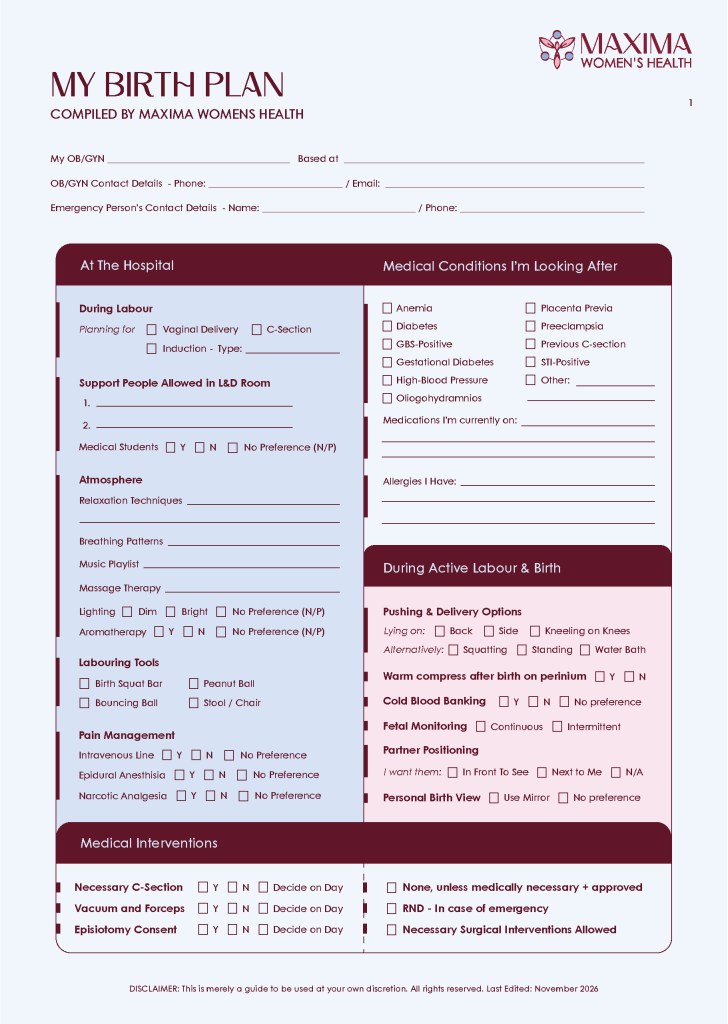
Free Printable Birth Plan Checklist
Use our 2-page checklist to help you prepare for your birth preferences discussion with your obstetrician or midwife.
You can download and print our ‘Maxima Birth Plan’ document, save it digitally or use it as a starting point for your own birth plan.
From the Maxima Consultation Room
A birth plan can feel like a lot to think about, especially if this is your first pregnancy. We understand that and have supported hundreds of women through their births.
You might wonder whether your doctor will actually read it, whether you are allowed to change your mind or whether having a birth plan means you are expecting your birth to go a certain way.
Here are some of the conversations that often come up when preparing for birth.
“When should I give my birth plan to my doctor or midwife?”
You do not have to wait until your final antenatal appointment to share your birth plan. In fact, it can be helpful to introduce your preferences during your antenatal visits, particularly once you have started thinking about labour, pain relief and your birth environment.
Many women begin drafting their birth plans during the second trimester and review them as their pregnancy progresses.
This gives you and your healthcare team time to discuss your preferences, clarify what is available at your planned place of birth and identify any considerations specific to your pregnancy.
You can bring a printed copy to an antenatal appointment, email it to your healthcare provider ahead of time or ask whether it can be included in your maternity notes.
A helpful tip:
Bring your birth plan to an appointment where you have enough time to discuss it. You do not need to cover every preference in one conversation.
“Will my doctor actually read my birth plan?”
This is a common concern, particularly when you have spent time thinking about your preferences and putting them into writing.
A birth plan is a useful communication tool, but it is important to remember that healthcare teams work within clinical, practical and time-sensitive circumstances.
Your doctor or midwife may not be able to discuss every individual preference in detail during a busy appointment or labour. This is why a clear, concise birth plan can be helpful.
Rather than presenting a long list of instructions, focus on the preferences that matter most to you.
For example:
- I would like my birth partner present whenever possible.
- I would appreciate an explanation before procedures are performed, where circumstances allow.
- I would like to explore different pain relief options.
- I would prefer skin-to-skin contact after birth, if my baby and I are well.
You can also ask your healthcare provider directly:
“I’ve put together a birth plan. Would you be able to look through it with me and let me know which preferences are likely to be possible?”
This opens the door to a conversation rather than leaving you wondering whether your plan has been seen.
“What if my doctor disagrees with something in my birth plan?”
Your birth plan should be a conversation between you and your healthcare team.
Sometimes, a preference may not be suitable for your individual circumstances. Other times, your doctor may explain that a particular option is not available at your planned birth facility.
For example, you may prefer to remain mobile throughout labour, but your healthcare team may recommend continuous monitoring because of a clinical concern. You also may have a preference regarding the timing of an intervention, but your doctor may recommend a different approach based on your or your baby’s wellbeing.
If a recommendation differs from your preference, it is reasonable to ask questions.
You might ask:
- Why are you recommending this?
- What are the benefits and risks?
- Are there any alternatives?
- Is there time for us to discuss the decision?
- What happens if we wait?
Informed consent and shared decision-making are important parts of respectful maternity care.
Your healthcare team should help you understand the reasons for a recommendation and involve you in decisions about your care wherever circumstances allow.
In an emergency, however, there may be very little time for a lengthy discussion.
The aim is to establish an understanding of your preferences and the clinical considerations that may affect them before labour begins.
“Can I change my birth plan once I’m in labour?”
Absolutely. Your birth plan is not a contract that you have to follow.
You may begin labour hoping to use breathing techniques, movement and other comfort measures, only to discover that you would prefer additional pain relief.
You may initially feel comfortable with a particular birth position but want to try something different as labour progresses. Your healthcare team may also recommend an intervention that was not part of your original plan. You are allowed to change your mind.
Your preferences may evolve as you experience labour, and your healthcare team can help you understand the options available at that point.
A flexible birth plan leaves room for these changes.
It is also worth discussing your preferences with your birth partner beforehand, so they understand that supporting you means listening to what you need in the moment—not holding you to decisions you made weeks earlier.
“What if I don’t know what I want yet?”
You do not need to have a definite answer for every part of your birth plan.
It is completely reasonable to feel unsure about pain relief, labour positions, monitoring or what you might prefer if an assisted birth or caesarean becomes necessary.
Your birth plan can include questions rather than decisions.
For example:
“I am not sure which pain relief option I would prefer. I would appreciate discussing the available options and their benefits and risks during labour.”
Or:
“I would like to understand when an assisted vaginal birth or caesarean birth may be recommended, so I can feel more prepared if either becomes necessary.”
Your antenatal appointments are an opportunity to explore these questions. You do not have to become an expert in every aspect of childbirth before your baby arrives. The purpose of preparation is to help you feel informed and supported—not to create more pressure.
“Should I have a different birth plan if I am having a planned caesarean?”
Yes, you can still have birth preferences if you are planning a caesarean birth.
A birth plan is not limited to vaginal birth.
You may wish to discuss:
- Whether your birth partner can be present during the procedure.
- Your preferences regarding communication and explanations.
- Whether you would like to see your baby being born, if possible.
- Skin-to-skin contact in theatre or recovery, if appropriate.
- Delayed cord clamping, where clinically suitable.
- Your preferences for feeding and newborn care.
- What happens if an unexpected situation requires a change in the plan.
Some preferences may depend on the type of anaesthesia used, the reason for your caesarean and the condition of you and your baby.
Your obstetrician and anaesthetist can help you understand what may be possible.
A planned caesarean can still be a birth experience in which your preferences, comfort and emotional wellbeing matter.
“What if I need an emergency caesarean or assisted birth?”
This is one of the reasons a flexible birth plan can be so valuable. Although you may have prepared for a particular type of birth, circumstances can change during labour.
Your healthcare team may recommend an assisted vaginal birth or caesarean if there are concerns about your baby’s wellbeing, labour progression or your health.
In these situations, the priority is to make the safest appropriate decision for you and your baby. If time allows, your healthcare team should explain what is happening, why a particular intervention is recommended and what the next steps may involve.
You can also include preferences in your birth plan regarding communication and support during unexpected situations.
For example:
“If my birth plan needs to change, I would appreciate clear communication about what is happening and why. I would like my birth partner to remain with me whenever possible.”
Preparing for these possibilities does not mean you are expecting something to go wrong. It means you are giving yourself an opportunity to understand the different ways your birth may unfold.
“Is a birth plan necessary if my pregnancy is high-risk?”
A birth plan can still be extremely useful if you have a high-risk pregnancy.
However, your individual medical circumstances may influence which preferences are appropriate or possible. For example, you may require additional monitoring, a planned induction, a caesarean birth or other medical interventions.
Your birth plan can help you communicate preferences regarding pain relief, support, communication, newborn care and your emotional wellbeing. It can also help you identify questions you would like to discuss with your obstetrician.
The most important thing is to create your plan in collaboration with your healthcare team, taking into account your pregnancy, medical history and the recommendations relevant to your care.
Your preferences still matter, even when your birth requires additional medical support.
“How detailed should my birth plan be?”
Your birth plan does not need to be a lengthy, end-all be-all map.
In many cases, a one- or two-page document is enough to communicate your most important preferences.
A plan that is easy to read can be particularly helpful when your healthcare team needs to understand your wishes quickly.
Focus on:
- Your most important preferences.
- The options you would like to discuss.
- Any relevant medical or personal considerations.
- Your preferences for communication and support.
- What you would like to happen if circumstances change.
You can keep a more detailed version for yourself if that helps you feel prepared. The version you share with your healthcare team should be clear, practical and easy to navigate.
The Maxima Takeaway
Your birth plan is an opportunity to prepare for one of life’s most significant transitions.
Your birth plan is there to support you—not to create expectations that you must meet. It is a way to understand your options, communicate what matters to you and feel more confident about the decisions that may arise during labour and birth.
The most important part of your birth plan is not the document itself. It is the conversations you have, the questions you ask and the support you receive along the way.
Remember:
- You are allowed to have preferences.
- You are allowed to ask questions.
- You are allowed to change your mind.
A good birth plan is not about controlling every moment. It is about helping you feel informed, respected and involved in your care.
Your birth may unfold differently from what you imagined. That does not make your preparation any less valuable. You deserve to feel informed, respected and supported—whatever your birth journey looks like.
CTA:
Ready to Prepare for Your Birth?
Antenatal consultations are an opportunity to discuss your birth preferences, explore your options and prepare for the different possibilities surrounding labour and delivery.
Book an antenatal consultation with Maxima Women’s Health to discuss your birth plan and prepare for your baby’s arrival with confidence.
Understanding Your Pregnancy Starts with Understanding Your Body
Every pregnancy is unique. Our team and specialists are here to support you with expert personalised guidance and compassionate care.
Book your pregnancy consultation with Maxima Women’s Health today.
Your Body Is Creating Something Extraordinary
Pregnancy asks your body to adapt, grow and change in remarkable ways. Feeling tired is often a reflection of the incredible work happening internally. Read more about your pregnancy journey on our Obstetrics Blog.
Leave a Reply