
Editorial note:
This Maxima Women’s Health article is intended for a screening and symptom awareness rather than a “cancer scare”.
It is important to understand here, there are times when our bodies tell us that something feels different, but it is not always easy to know what that means.
If you have any symptoms that are concerning to you in any way, it is best to get them checked out by a professional who can guide you compassionately no matter the results.
————
Perhaps your stomach has been feeling unusually bloated. You are getting full halfway through a meal, experiencing an unfamiliar ache in your pelvis, or finding yourself needing to urinate more often than usual.
It is easy to put these changes down to a busy week, something you ate, hormonal fluctuations or the everyday discomforts that many women experience. Often, there is a perfectly ordinary explanation.
However, sometimes these symptoms that seem like minor inconveniences in your daily life are worth a closer look. Understanding what to look out for, knowing your family history and feeling comfortable speaking to your doctor can help you make informed decisions about your health.
Ovarian cancer can be difficult to recognise because its symptoms are often subtle and overlap with those of common digestive, urinary and gynaecological conditions. There is no single early warning sign that reliably identifies the disease, and many women do not realise that their symptoms deserve investigation.
This is not about worrying over every ache or change. It is more about understanding your body and knowing when something you feel deserves your attention.
What Is Ovarian Cancer?
The ovaries are two small reproductive organs situated on either side of the uterus. They release eggs during the reproductive years and produce hormones, including oestrogen and progesterone, which help regulate the menstrual cycle and support other aspects of health.

Download our ‘Formation of Ovarian Cancer Diagram’ here
Ovarian cancer occurs when cells in or around the ovaries develop abnormal changes that allow them to grow uncontrollably. Depending on the cancer type, these cells may form a mass, spread to nearby structures or eventually travel to other parts of the body.
The Term ‘Ovarian Cancer’ Covers Several Types
Many of which include:
Epithelial Ovarian Cancer
This is the most common group of ovarian cancers. It develops from epithelial cells associated with the surface of the ovary or other tissues within the female reproductive tract. High-grade serous carcinoma is the most common and one of the most aggressive subtypes.
These changes usually develop through a series of events rather than one isolated mutation. Inherited BRCA variants can create an increased susceptibility from birth, while additional changes may develop later in particular cells
Research suggests that many of these cancers begin in the fimbriae — the delicate, finger-like ends of the fallopian tubes closest to the ovaries — before spreading to the ovaries or elsewhere in the abdomen. This discovery has changed how scientists understand the origins of some ovarian cancers and has influenced prevention strategies for women with inherited genetic risk.
Germ Cell Tumours
Germ cell tumours develop from the cells that are involved in producing eggs. These cells have a distinct developmental history, which helps explain why their tumours differ from epithelial cancers. They are relatively uncommon and occur more frequently in adolescents and younger women.
During development, germ cells must move to the developing reproductive organs, mature and maintain the ability to pass genetic information on to the next generation. If the biological processes controlling their growth and development become disrupted, a tumour may form.
Different germ cell tumour subtypes have different molecular characteristics. Although some types can grow quickly, many respond well to treatment, particularly when diagnosed early. Depending on the tumour type, treatment may be planned to preserve fertility where medically appropriate.
Sex Cord-Stromal Tumours
These arise from the connective and hormone-producing tissues that support the ovary. Some produce hormones such as oestrogen or testosterone, which can lead to symptoms such as unexpected vaginal bleeding, changes in menstrual patterns or other hormonal changes.
Their behaviour varies depending on the specific tumour type, so accurate diagnosis is important in guiding treatment.
Why Ovarian Cancer Symptoms Can Be Easy To Miss
There is no single symptom that reliably identifies ovarian cancer. The difficulty is that early symptoms may be vague, intermittent or similar to those caused by digestive issues, hormonal changes, urinary tract conditions or benign ovarian cysts.
For example, bloating may be related to constipation, food intolerances or changes during the menstrual cycle. Pelvic pain may be associated with ovulation, endometriosis, fibroids or other gynaecological conditions.
However, researchers have found that certain symptom patterns occur more frequently in women with ovarian cancer.
In a 2004 case-control study, Goff and colleagues compared symptoms reported by women attending primary care clinics with those reported by women with pelvic masses. Increased abdominal size, bloating, urinary urgency and pelvic pain were more strongly associated with ovarian cancer in the study population. Women with malignant masses also tended to experience symptoms more frequently and with greater severity (Goff et al., 2004).
Now 2004 is a long time from where we currently are, but this research helped demonstrate why the pattern of symptoms matters, not simply whether a symptom occurs.
It does not mean that bloating or pelvic pain is a reliable way to diagnose cancer. Nor does it mean that every woman with these symptoms requires cancer testing. Instead, it supports paying attention to changes that persist, become more frequent or differ from your normal pattern.
Symptoms To Pay Attention To
Women’s bodies naturally change throughout the menstrual cycle, and occasional bloating, pelvic discomfort or changes in bowel habits are common. What can be more useful is noticing when a symptom is new, keeps returning, lasts longer than usual or begins to affect your everyday life.
Ovarian cancer symptoms can overlap with digestive, urinary and other gynaecological conditions. There is no symptom diary that can confirm or rule out cancer, but keeping a simple record can help you explain what you have been experiencing and help your doctor decide whether further investigation is needed.
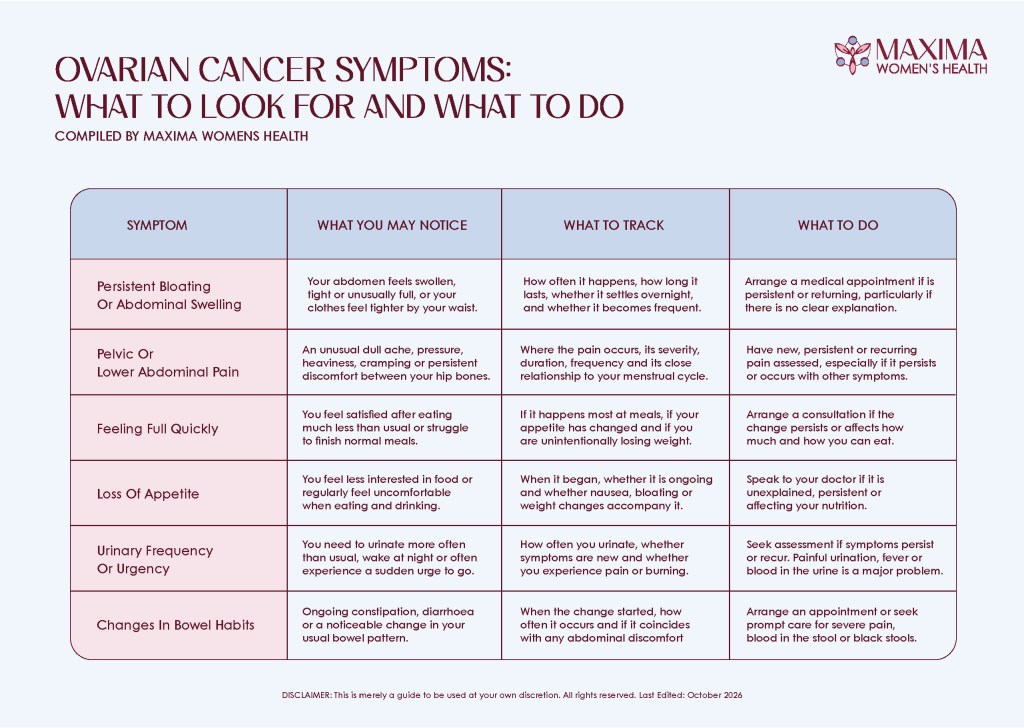
The image above depicts only half of the symptoms to look out for. For a full list of symptoms, download our full guide below.
Download our full ‘Ovarian Cancer Symptoms’ guide here
How To Keep a Useful Symptom Record
You do not need to write down every bodily sensation. A short, consistent record is often more useful than trying to remember everything when you see your doctor.
The key is not to monitor every bodily sensation anxiously. It is to notice when something becomes persistent, frequent, progressive or distinctly unusual for you.
For each symptom, consistently note the following:
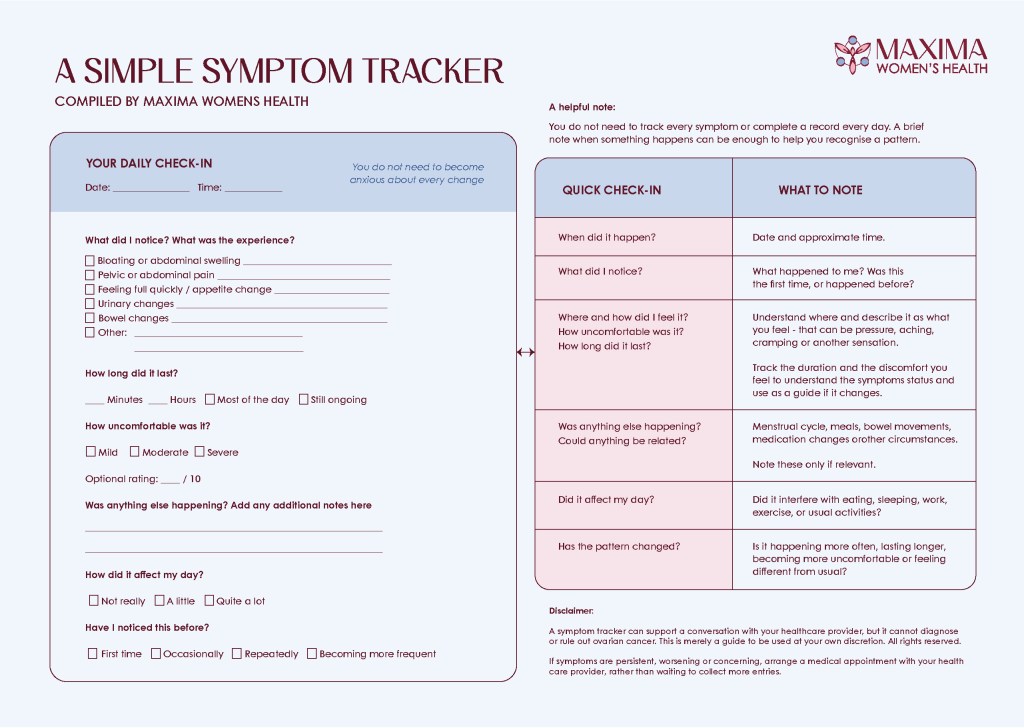
Download our ‘Simple Symptom Tracker’ here and start your note-taking journey to better healthcare
When Should You Act On a Pattern?
Clinical guidance highlights persistent or frequent abdominal bloating, early fullness or loss of appetite, pelvic or abdominal pain, and increased urinary urgency or frequency as symptoms that warrant assessment.
One guideline uses symptoms occurring more than 12 times a month as a particular reason to investigate; this is not a threshold you must reach before seeking help.
Do not delay an appointment if symptoms are persistent, worsening or concerning to you.
Arrange a medical appointment if symptoms are new and keep returning, become more frequent, occur together or differ from your usual experience.
If you have a strong family history of ovarian or related cancers, mention this when seeking advice.
Seek urgent medical attention for sudden, severe abdominal or pelvic pain, particularly with vomiting, fever, fainting or significant weakness.
Remember:
Tracking symptoms is a tool for communicating with your healthcare provider, not a test for cancer. Many of these symptoms have common, non-cancerous explanations.
You deserve to have persistent changes investigated without feeling that you need to prove they are serious first.
What Causes These Genetic Changes In The First Place?
It is important to understand that there is rarely one single explanation.
Several processes may contribute:
- Inherited genetic variants: Some people are born with a variant that increases their susceptibility to particular cancers. BRCA1, BRCA2 and certain other cancer-predisposition genes are examples.
- Acquired mutations: Genetic changes can develop in individual cells during a person’s lifetime. These are called somatic mutations and are not necessarily inherited or passed on to children.
- Ageing and accumulated cellular damage: Cells experience DNA damage as part of normal life. Most damage is repaired, or the affected cell is removed, but some changes can persist and accumulate.
- Disrupted cell signalling: Mutations may affect the biological systems that tell cells when to grow, divide, repair themselves or die. When these controls fail, abnormal cells may gain a survival advantage.
- The surrounding tissue environment: Inflammation, tissue repair and other local biological processes may contribute to cancer development in some contexts. Researchers continue to investigate how these processes interact with inherited susceptibility and acquired mutations.
A risk factor or having these processes within you is not necessarily a direct cause, and many cancers develop without a clearly identifiable trigger.
Scientists understand several important molecular pathways, but they cannot explain the exact cause of every individual ovarian cancer.
A 2026 South African Medical Journal study by Barnard, Rossouw and Gilfillan examined patients referred to a clinical genetics centre in Johannesburg because of suspected hereditary gynaecological cancer risk. The study highlights the importance of assessing hereditary cancer beyond BRCA alone and considering a wider range of genes and family-history patterns in appropriate patients (Barnard, Rossouw and Gilfillan, 2026).
Other genes involved in DNA repair and cancer predisposition may also be relevant. Which genes should be tested depends on the person’s diagnosis, family history and clinical circumstances.
Who Is At Greater Risk Of Ovarian Cancer?
Ovarian cancer can affect women without any obvious risk factors. Having one or more risk factors does not mean you will develop the disease, and not having known risk factors does not guarantee that you will not.
Some factors influence risk through inherited genetics, while others relate to age, reproductive history or previous medical conditions.
Age
The risk of epithelial ovarian cancer generally increases with age, and many cases occur after menopause. However, ovarian cancer is not exclusive to older women. Certain less common tumour types are more likely to occur in younger women.
New or persistent symptoms deserve attention at any age.
Family History
A family history of ovarian cancer can be important, particularly when several relatives have had related cancers or when diagnoses occurred at younger ages.
A pattern of ovarian, breast, pancreatic, prostate or certain colorectal and uterine cancers within a family may point towards an inherited cancer predisposition. The significance depends on the relatives affected, their relationship to you, their ages at diagnosis and the types of cancer involved.
This is why knowing your family history can be useful even when you feel well.
Inherited Genetic Variants
Everyone—regardless of family history—carries normal copies of BRCA1 (located on chromosome 17) and BRCA2 (located on chromosome 13). They act as tumor suppressors that produce proteins to repair broken DNA and maintain genomic stability.
Some people inherit a change in a gene that increases their lifetime risk of developing particular cancers. BRCA1 and BRCA2 are two of the best-known examples, but other genes and inherited syndromes can also be involved.
How Are BRCA Variants Inherited?
BRCA-associated cancer predisposition is usually inherited in an autosomal dominant pattern. This means a person with a germline pathogenic variant has a 50% chance of passing that variant to each biological child, regardless of the child’s sex.
A variant can be inherited through either the mother’s or the father’s side of the family. This is an important distinction because a family history of breast or ovarian cancer on the paternal side matters just as much as one on the maternal side.
A family may also have a harmful variant without an obvious history of cancer, because relatives may be few in number, may not have lived to the ages when cancer typically develops, or may not have inherited the variant.
Endometriosis and Other Factors
Endometriosis has been associated with an increased risk of certain ovarian cancer subtypes, particularly endometrioid and clear cell cancers. However, the absolute risk for an individual remains dependent on several factors, and most women with endometriosis will not develop ovarian cancer.
Other associations include reproductive and hormonal factors, although the strength and clinical significance of these relationships vary. Risk factors should be considered together rather than treated as a checklist that can predict an individual’s future.
The underlying biology is complex, and a review of ovarian cancer epidemiology highlights the importance of considering different cancer subtypes and their distinct risk profiles (Lheureux et al., 2019).
From The Maxima Consultation Room
If something feels different and is not settling, speak to your healthcare provider. Paying attention to your body is not overreacting; it is a practical part of looking after your health.
Knowing your family history can also help you understand whether inherited risk needs further assessment. BRCA1 and BRCA2 are important, but they are not the only genes involved, and genetic counselling can help make sense of what your individual history means.
“Does bloating mean I might have ovarian cancer?”
Bloating is common and usually has a non-cancerous explanation. What matters is whether it is new, persistent, becoming more frequent or accompanied by other changes. If it does not settle as usual or concerns you, arrange a medical assessment.
“Can ovarian cancer affect me even though I have regular periods?”
Yes. Having regular periods does not rule out ovarian cancer. Menstrual changes are not a reliable way to identify or exclude the disease, so persistent symptoms should be assessed on their own merits.
“Can ovarian cancer be screened for before my symptoms appear?”
This is an important question, particularly for women who want to be proactive about their health. At present, there is no established routine screening test that has been shown to reduce ovarian cancer deaths in asymptomatic women at average risk.
Large screening studies have evaluated approaches such as transvaginal ultrasound and CA-125 blood testing. However, evidence reviews have not demonstrated a meaningful reduction in ovarian cancer mortality through routine screening of asymptomatic, average-risk women. Screening can also produce false-positive results, leading to unnecessary investigations or surgery and their associated risks (Henderson et al., 2018).
This does not mean that symptoms should be ignored or that investigations are unhelpful. Investigating symptoms is different from screening someone who has no symptoms. If you are concerned and want further testing, your doctor may recommend targeted assessment or referral to a specialist.
“Should I ask for a CA-125 blood test if I am worried?”
Discuss your symptoms and risk factors with your doctor first. CA-125 has limitations and can be elevated for reasons other than cancer. It is not recommended as a stand-alone screening test for asymptomatic women at average risk.
“If my mother or grandmother had breast cancer, should I have BRCA testing for other cancers?”
Not necessarily, but it is worth discussing your family history with your doctor. The age at diagnosis, number of affected relatives, cancer types your family has had and any known genetic results help determine whether genetic counselling or testing is appropriate. Family history on your father’s side matters too.
“What if nobody in my family has had ovarian cancer?”
A lack of known family history does not completely rule out hereditary risk.
Some inherited variants may be present in families where cancer has not yet occurred or where the pattern is not immediately obvious. In addition, many ovarian cancers arise without an identifiable inherited cause.
“If I have a risk factor for a specific type of ovarian cancer, can I be susceptible to the other types as well?”
One important distinction: a risk factor is not necessarily a direct cause, and many cancers develop without a clearly identifiable trigger. Scientists understand several important molecular pathways, but they cannot explain the exact cause of every individual ovarian cancer.
Understanding these different types matters because ovarian cancer is not one single disease. Each type has its own biology, typical age of presentation, pattern of growth and response to treatment.
The differences between ovarian cancers influence how cancer is investigated and managed. They also remind us why a person’s symptoms, age and medical history should be considered together rather than assuming that every ovarian tumour will behave in the same way. These distinctions matter because factors like age, symptoms, risk factors and more, require different methods of treatment.
Epithelial ovarian cancer is particularly important in discussions about hereditary risk because some cases are associated with inherited changes in genes involved in repairing damaged DNA, including BRCA1 and BRCA2 (Lynch et al., 2009).
When Should You Speak To Your Doctor?
You do not need to wait until symptoms become severe before seeking medical advice.
Arrange an appointment with your doctor or gynaecologist if you experience new symptoms that persist, recur frequently or gradually worsen, especially if several symptoms occur together.
It is also worth discussing symptoms sooner if you have a strong family history of ovarian or breast cancer, a known inherited cancer-risk variant, or a personal history that raises concern.
Remember, most women who experience bloating, urinary changes or pelvic pain will most likely not have ovarian cancer. The purpose of speaking to a healthcare professional is to understand what is causing the symptoms.
If tests confirm ovarian cancer is present, your healthcare provider can identify the appropriate next steps.
The Maxima Takeaway
Ovarian cancer is not one single disease, and neither is every ovarian mass cancerous. Many ovarian cysts and growths are benign. Medical assessment helps determine what a finding means in the context of your symptoms, age and individual circumstances.
Knowing your family history can also help you understand whether inherited risk needs further assessment. BRCA1 and BRCA2 are important, but they are not the only genes involved, and genetic counselling can help make sense of what your individual history means.
Ovarian cancer can be difficult to recognise because its symptoms often resemble common digestive, urinary or gynaecological concerns. Persistent bloating, pelvic pain, early fullness and changes in urination do not automatically indicate cancer, but new or ongoing symptoms deserve attention.
If something feels different and is not settling, speak to your healthcare provider. Paying attention to your body is not overreacting; it is a practical part of looking after your health.
Changes in your body?
You do not need to become anxious about every change in your body. You deserve to understand those changes, ask questions and receive appropriate care when you need it.
If you have persistent bloating, pelvic discomfort or other changes that concern you, book a consultation with your healthcare provider to discuss your symptoms and the next steps.
Have family history of ovarian or breast cancer?
Speak to your doctor about whether genetic counselling could help you understand your individual risk.
Know the signs, understand your risk and share this article with someone who could benefit from learning more about your body and ovarian cancer.
Leave a Reply