
Editorial note:
This Maxima Women’s Health article is intended for a screening and symptom awareness rather than a “cancer scare”.
Cervical cancer is one of the most important cancers to understand when it comes to women’s preventive healthcare. South Africa in particular has had a high rate of cervical cancer, commonly attributed to the fact that not enough women are screened regularly.
Although a diagnosis can feel frightening, there is encouraging news: most cervical cancers can be prevented through HPV vaccination, appropriate screening and timely treatment of precancerous changes.
Screening can detect early changes in the cervix, which can be treated and may save your life. Yet many women are unsure when they should have a Pap smear, whether they need one if they have received the HPV vaccine, or what it means if a test comes back positive for human papillomavirus (HPV).
These are important things to think and ask about. They also deserve clear answers without unnecessary fear or confusion.What Is Cervical Cancer?
The cervix is the lower, narrow part of the uterus that connects the uterus to the vagina. It plays an important role in the reproductive system, including allowing menstrual blood to pass from the uterus and dilating during childbirth.
Cervical cancer develops when cells in the cervix begin to grow abnormally and uncontrollably. The cancer usually develops gradually. In most cases, it begins with a persistent infection caused by certain high-risk types of HPV. Over time, this infection can cause changes in the cells of the cervix. Some of these changes may eventually develop into cancer if they are not identified and treated.
These cells can form a tumour and, if the disease progresses, may invade surrounding tissues or spread to other parts of the body.

Download our “Formation of Cervical Cancer” Graphic →
Most cervical cancers develop in the cells lining the cervix. Before invasive cancer develops, however, abnormal changes may occur over several years. These changes are often called precancerous cervical lesions or cervical intraepithelial neoplasia (CIN).
Not every abnormal cell change progresses to cancer. Some resolve naturally, while others require monitoring or treatment, depending on their severity and the person’s clinical circumstances.
This gradual development creates an important opportunity for prevention: screening can identify concerning changes before they become invasive cancer.
Cervical cancer remains a significant public health concern in South Africa. The National Department of Health’s cervical cancer prevention policy recognises vaccination, screening, treatment of precancerous changes and access to cancer care as interconnected parts of prevention and management (National Department of Health, South Africa, 2017).
Understanding this process helps explain why vaccination and routine screenings are so important. They work at different stages of prevention, giving healthcare professionals opportunities to reduce the risk of cervical cancer before it becomes life-threatening.
The goal is not simply to detect cancer earlier. It is to prevent as many cases as possible from developing in the first place.
HPV and It’s Link To Cervical Cancer
Human papillomavirus, commonly known as HPV, is a group of viruses that can infect the skin and the moist surfaces lining parts of the body, including the genital area, anus and throat.
HPV is extremely common. Most sexually active people will encounter at least one type during their lifetime, often without ever knowing they have been infected. In most cases, the immune system controls the infection naturally.
HPV is usually transmitted through intimate skin-to-skin contact, including sexual contact. Penetrative sex is not necessary for transmission, and using condoms reduces exposure but does not eliminate the risk because HPV can affect skin that condoms do not cover.
There are many different HPV types, including more than 200 different types of viruses. They are broadly described as low-risk or high-risk according to their potential to cause cancer.
- Low-risk HPV types can cause genital warts but are not usually responsible for cervical cancer.
- High-risk HPV types can cause persistent cellular changes that may eventually develop into cancer.
HPV types 16 and 18 are particularly important because they account for a substantial proportion of cervical cancers worldwide. Other high-risk types can also cause disease, which is one reason screening remains important even after vaccination.
How Can HPV Lead To Cervical Cancer?
A high-risk HPV infection does not automatically mean that someone will develop cervical cancer.
The concern is a persistent infection, meaning the body does not successfully clear or control the virus over time. Persistent high-risk HPV can interfere with the normal processes that regulate cervical cell growth, allowing abnormal cells to develop and, in some cases, progress towards cancer.
H4: The process generally follows this pattern:
- HPV exposure: The virus infects cells on the cervix.
- Immune response: In many people, the immune system controls the infection without causing lasting problems.
- Persistent infection: In some people, a high-risk HPV infection remains for an extended period.
- Cellular changes: The infection may lead to precancerous changes in cervical cells.
- Possible progression: If significant abnormalities are not identified and appropriately managed, some may progress to invasive cervical cancer.
This progression usually takes years, although the timeline varies. Regular screening provides opportunities to identify and manage abnormalities before they become cancerous.
Why Is Routine Cervical Screening So Important?
One of the challenges with cervical cancer is that early precancerous changes generally do not cause noticeable symptoms.
You can feel completely healthy while abnormal cells are developing. Waiting until symptoms appear therefore misses an important opportunity for prevention.
Cervical screening is designed to identify either high-risk HPV infections or abnormal cervical cells before cancer develops, depending on the test being used.
The two main approaches are HPV testing and cervical cytology, commonly known as a Pap smear. They assess different things, and neither should be confused with a general examination of the entire reproductive system.
What Is a Pap Smear?
A Pap smear, or Pap test, is a screening test that examines cells collected from the cervix.
During the procedure, a healthcare professional gently inserts a speculum into the vagina to visualise the cervix. A small brush or sampling instrument is used to collect cervical cells, which are sent to a laboratory for examination.
The laboratory looks for abnormal changes in the cells that may indicate precancerous lesions or, less commonly, cancer.
A Pap smear does not directly test for every HPV type. Instead, it identifies cellular changes that may have been caused by HPV or other processes.
The test is generally quick. Some people experience pressure or mild discomfort during the procedure, and there may be light spotting afterwards. It should not usually cause significant pain. If you have concerns about discomfort, previous trauma or anxiety, tell your healthcare professional so that adjustments can be discussed.
What Is an HPV Test?
An HPV test looks for high-risk types of HPV associated with cervical cancer.
A cervical sample is collected in a similar way to a Pap smear, although some testing methods may allow a person to collect their own sample under an approved screening programme.
An HPV test can identify a high-risk infection before abnormal cells become apparent. This is one reason the World Health Organization recommends HPV DNA testing as the preferred primary screening approach where appropriate testing programmes are available.
Depending on the setting, screening may use HPV testing alone, cytology alone or a combination of tests. The most appropriate approach depends on the screening programme, available services, age, previous results and individual clinical circumstances.
Pap Smear vs HPV Test: What Is The Difference?
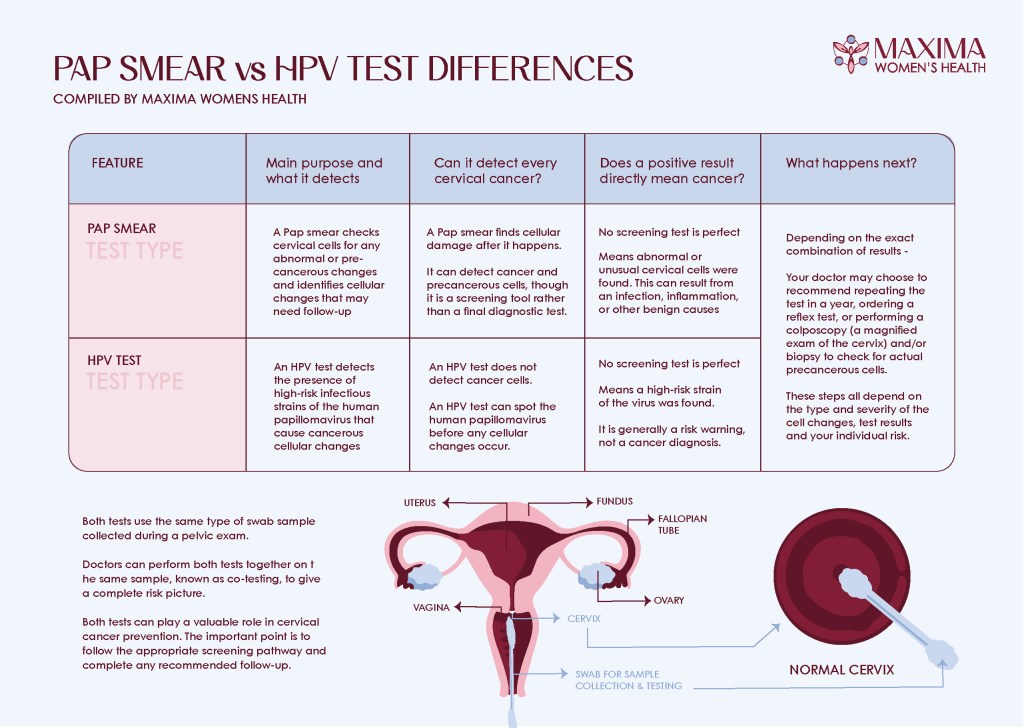
Download our “Pap Smear vs HPV Test Differences Table” Graphic →
The HPV Vaccine: Preventing Cervical Cancer Before It Starts
Screening helps identify high-risk HPV infections or abnormal cervical cells. The HPV vaccine works earlier in the process by preventing infection with important cancer-causing HPV types.
This makes vaccination one of the most effective tools available for reducing the future risk of cervical cancer.
HPV vaccines stimulate the immune system to produce antibodies that help protect against targeted HPV types. They are preventive vaccines, meaning they work best when given before exposure to the virus.
The vaccines do not contain live HPV capable of causing infection, and they cannot give someone HPV.
Who Should Receive The Hpv Vaccine?
HPV vaccination is most effective when given before a person becomes sexually active, which is why routine vaccination is recommended during childhood or early adolescence.
The World Health Organization recommends HPV vaccination as a core component of cervical cancer prevention, with schedules determined by age, immune status and national recommendations.
In South Africa, the national school-based HPV vaccination programme was introduced in 2014, initially targeting eligible Grade 4 girls aged nine and older in public schools. The programme has played an important role in expanding access to vaccination.
Vaccine schedules and eligibility can change as national policies are updated. The number of doses recommended may depend on age at vaccination, immune status and the current programme. Parents and caregivers should confirm the applicable schedule with a healthcare professional or local health service.
Although vaccination is most effective before HPV exposure, older adolescents and some adults may also benefit. Eligibility and likely benefit should be discussed individually, taking previous vaccination and local guidance into account.
HPV vaccination is also relevant to boys because HPV can cause cancers and other conditions beyond cervical cancer. Vaccinating eligible boys can help reduce HPV-related disease and transmission.
How Effective Is The HPV Vaccine?
HPV vaccines have demonstrated substantial protection against the HPV types they target, particularly when administered before exposure.
The International Agency for Research on Cancer identifies HPV vaccination and screening followed by appropriate treatment as complementary strategies for preventing cervical cancer [6].
The vaccine does not protect against every high-risk HPV type, however. This means that vaccinated people can still develop HPV infections and, in some circumstances, cervical abnormalities.
Vaccination substantially reduces risk; it does not make that risk zero.
Is The HPV Vaccine Safe?
HPV vaccines have been extensively studied and used in national immunisation programmes. Their safety is monitored through clinical research and ongoing surveillance.
The most common side effects are generally mild and temporary, including:
- Pain, redness or swelling at the injection site.
- Headache.
- Mild fever.
- Tiredness or muscle discomfort.
Some adolescents may feel dizzy or faint after vaccination, which is why it is sensible to remain seated and follow the healthcare professional’s advice after receiving the injection.
Severe allergic reactions are rare. Anyone with a history of a serious allergic reaction to a previous dose or a vaccine component should discuss this with their healthcare provider before vaccination.
Questions about safety are understandable, particularly when making decisions for children. A healthcare professional can explain the benefits, possible side effects and recommended schedule in the context of the individual’s health.
From The Consultation Room
Directly from our offices and experiences, these are common questions we’ve received about HPV screenings, cervical cancer and test results.
“I’ve only had one sexual partner. Do I still need cervical screening?”
Yes, if you are due under the screening guidance that applies to you. HPV is common, and a person can acquire it from a single partner. Infection may remain undetected for years, so the number of sexual partners cannot determine whether screening is necessary.
“Does an HPV diagnosis mean I have cervical cancer?”
No. An HPV-positive result is not the same as a cervical cancer diagnosis.
An HPV test detects the presence of the virus or specific high-risk types. It does not, on its own, establish whether cancer is present.
Many HPV infections resolve without treatment. When high-risk HPV is detected, the next step depends on factors such as the test result, previous screening history, age and individual risk.
A healthcare professional may recommend repeat testing, a Pap smear, colposcopy or a biopsy, depending on the circumstances.
It is also important to understand that an HPV result cannot reliably tell you when the infection began or from whom it was acquired. HPV can remain undetected for years, and a positive result is not evidence of infidelity.
An HPV diagnosis should be approached as a healthcare matter, not a judgement about someone’s sexual history.
“If I’ve had the HPV vaccine, do I still need a Pap smear?”
Yes, if you are due for cervical screening under the recommendations that apply to you.
The HPV vaccine protects against selected HPV types, but it does not cover every type that can cause cervical cancer. Screening therefore remains an important part of preventive care.
Vaccination and screening are not competing alternatives. One helps prevent important HPV infections; the other identifies infections or cellular changes that may require follow-up.
Together, they provide stronger protection than relying on either approach alone.
“When should I have a Pap smear or cervical screening test?”
There is no single screening schedule that is appropriate for every woman in every country. Recommendations differ according to the screening method available, age, HIV status, previous results and personal medical history.
In South Africa, the National Department of Health’s 2017 Cervical Cancer Prevention and Control Policy provides for three free cervical screening tests at ten-year intervals for asymptomatic women aged 30 and older who are HIV-negative and use public-sector health services. The policy also provides for a different screening pathway for women living with HIV (National Department of Health, South Africa, 2017).
These are public-sector policy provisions, not a universal recommendation for every individual. International guidance and newer screening approaches may differ, and local implementation can evolve.
Your screening schedule may need to be different if you:
- Are living with HIV or another condition that affects your immune system.
- Have previously had an abnormal cervical screening result.
- Have a history of cervical precancer or cervical cancer.
- Have been advised to undergo more frequent follow-up.
- Experience symptoms that require diagnostic investigation rather than routine screening.
If you are unsure when your last screening test was performed, or whether you are due for another, speak to your gynaecologist or healthcare provider.
Do not assume that you no longer need screening because you feel healthy, have been in a long-term relationship or have received the HPV vaccine.
“My HPV test is positive. Does my partner need treatment?”
A positive HPV result does not automatically mean that either partner needs treatment. There is no routine treatment that eliminates HPV itself in every case; management focuses on associated conditions, such as genital warts or cervical abnormalities, when present.
Discuss any concerns about symptoms, vaccination or other sexually transmitted infections with your healthcare professional. An HPV result alone cannot establish when an infection was acquired.
“Why is my Pap smear result abnormal?”
An abnormal result does not automatically mean that you have cancer.
The result may indicate mild cellular changes, more significant abnormalities or findings that require further investigation. Some changes resolve naturally, while others need closer monitoring or treatment.
Depending on the result, your healthcare professional may recommend repeat testing, HPV testing, colposcopy or a biopsy.
Colposcopy is an examination in which a clinician uses a magnifying instrument to inspect the cervix more closely. A small tissue sample may be taken if an area looks abnormal.
If precancerous changes are confirmed, treatment may involve removing or destroying the affected tissue, depending on the type, extent and location of the abnormality. The aim is to prevent progression to cancer while taking individual circumstances, including future pregnancy plans, into account.
The most important thing is to complete the recommended follow-up. An abnormal screening result is a reason to investigate further, not a reason to assume the worst.
The Maxima Takeaway
Cervical cancer prevention is not about expecting the worst. It is about understanding what is within your control and making informed decisions before a problem develops.
HPV is common, and having an HPV infection does not mean you have cancer. Most infections are controlled by the immune system, while appropriate screening can identify high-risk infections or cellular changes that need attention.
The HPV vaccine helps prevent infections associated with a substantial proportion of cervical cancers. Pap smears and HPV testing offer opportunities to detect potential problems early, and follow-up care allows precancerous changes to be managed before they progress.
If you are unsure whether you need vaccination, have fallen behind on screening or have received an abnormal result, speak to a healthcare professional about the next appropriate step.
Preventive healthcare does not need to be complicated. It begins with asking questions, understanding your options and following through with care.
At Maxima Women’s Health, we believe that informed women are better equipped to make decisions about their health. Understanding cervical cancer is one step towards protecting your wellbeing, now and in the years ahead.
Your Next Step
If you’re due for screening – Book an appointment with Maxima Women’s Health to discuss a Pap smear or HPV test.
If you’re considering HPV vaccination – Ask us about eligibility, the recommended schedule and where vaccination might be available for you.
If you’ve received an abnormal result – Contact your healthcare professional or book an appointment with us to clarify the result and arrange any recommended follow-up.
Leave a Reply